

A Decade of Discovery: Major Advances in Medical Science From Leading Journals
DOI:
https://doi.org/10.14740/aicm28Keywords:
Programmable therapeutics, Computational biology, CRISPR genome editing, Single-cell and spatial omics, AI-driven clinical medicine, CAR-T immunotherapy, Liquid biopsy, GLP-1 metabolic therapeuticsAbstract
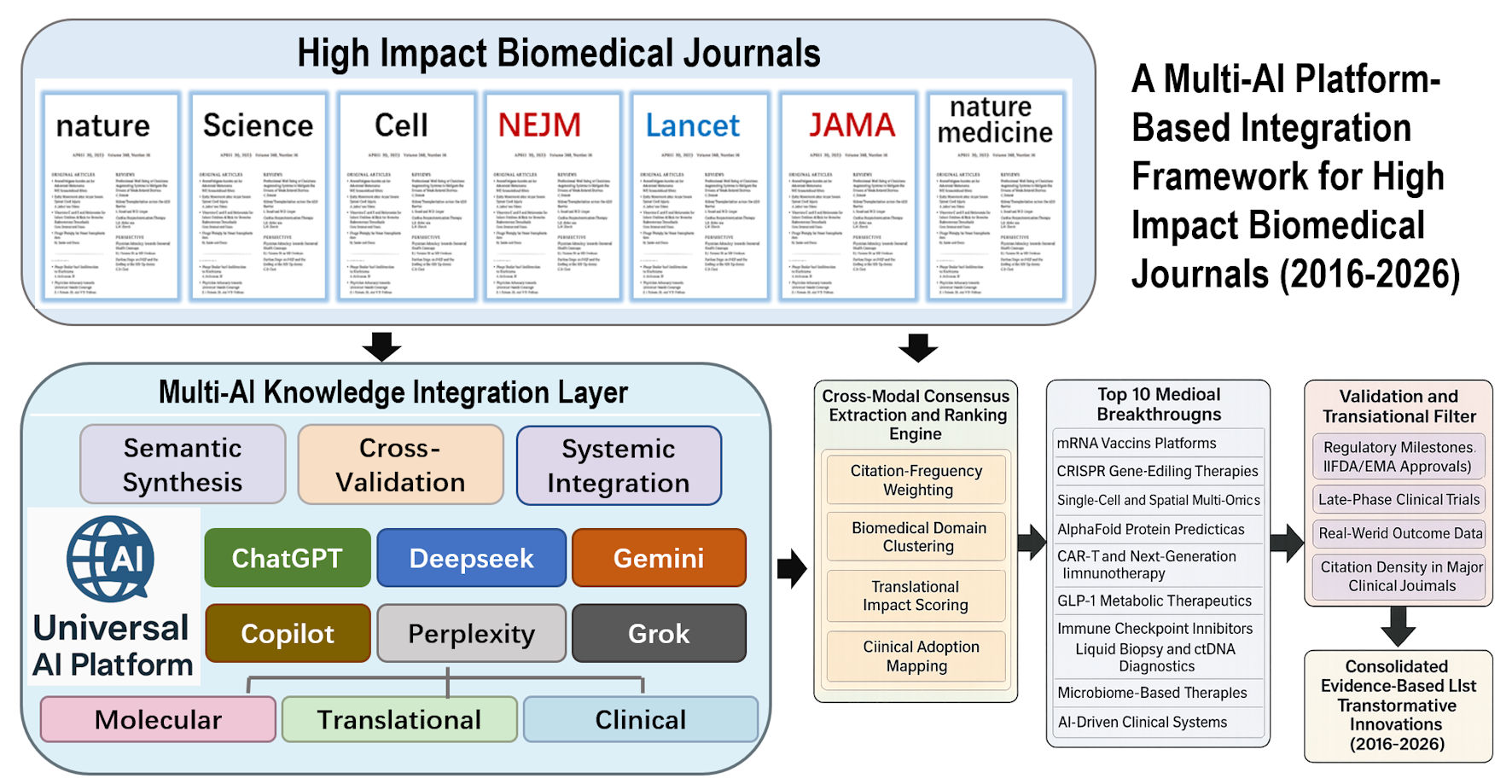
Over the past decade, biomedical science has undergone a profound transformation driven by advances in programmable therapeutics, computational biology, and systems-level reconceptualization of disease. To systematically identify the most influential breakthroughs from 2016 to 2026, we developed a multi-layered synthesis framework that integrates discoveries from leading journals (Nature, Science, Cell, New England Journal of Medicine (NEJM), The Lancet, JAMA, Nature Medicine) with the analytical capabilities of multiple artificial intelligence (AI) platforms, including ChatGPT, DeepSeek, Gemini, Copilot, Perplexity, and Grok. Each AI system contributed complementary strengths, including semantic synthesis, mechanistic interpretation, citation-grounded verification, translational mapping, and trend detection, allowing for robust cross-validation across basic, translational, and clinical domains. Through this multi-AI, multi-journal integration pipeline, we identified 10 breakthroughs that consistently ranked as the most transformative of the decade: mRNA vaccine platforms, clustered regularly interspaced short palindromic repeats (CRISPR)-based genome editing, single-cell and spatial multi-omics, AI-driven protein structure prediction (AlphaFold), chimeric antigen receptor T-cell (CAR-T) and engineered cellular immunotherapies, glucagon-like peptide-1 (GLP-1) receptor agonists and incretin-based metabolic therapeutics, immune checkpoint blockade, circulating tumor DNA (ctDNA) liquid biopsy diagnostics, microbiome-based therapeutics, and AI-enabled clinical decision systems. These advances collectively demonstrate a shift from descriptive biology to programmable intervention, from static tissue analysis to high-resolution cellular ecosystems, and from traditional diagnostics to real-time, data-driven clinical intelligence. A final translational validation layer, incorporating US Food and Drug Administration (FDA)/European Medicines Agency (EMA) approvals, late-phase clinical trial outcomes, real-world evidence, and citation density in major clinical journals, ensured that each breakthrough demonstrated both scientific novelty and clinical impact. Together, these findings highlight a decade defined by convergence: molecular engineering, computational prediction, and systems-level understanding now operate as integrated pillars of modern medicine. This synthesis provides a rigorous, AI-enhanced framework for mapping biomedical progress and offers a foundation for anticipating the next generation of transformative medical innovations.
Published
Issue
Section
License
Copyright (c) 2026 The authors

This work is licensed under a Creative Commons Attribution 4.0 International License.