

A Code-Free Visual Machine Learning Workflow for Automated Iron Deficiency Screening Using Routine Hematological Parameters
DOI:
https://doi.org/10.14740/aicm33Keywords:
Iron deficiency anemia, Complete blood count, No-code machine learning, Orange Data Mining, Logistic regression, Clinical decision supportAbstract
Background: Iron deficiency anemia is a major global health burden requiring early screening. Complete blood count (CBC) parameters—hemoglobin (Hb), mean corpuscular volume (MCV), mean corpuscular hemoglobin (MCH), and mean corpuscular hemoglobin concentration (MCHC)—are key indices used to diagnose this condition. We evaluated machine learning algorithms to differentiate iron deficiency from healthy profiles using standard CBC metrics.
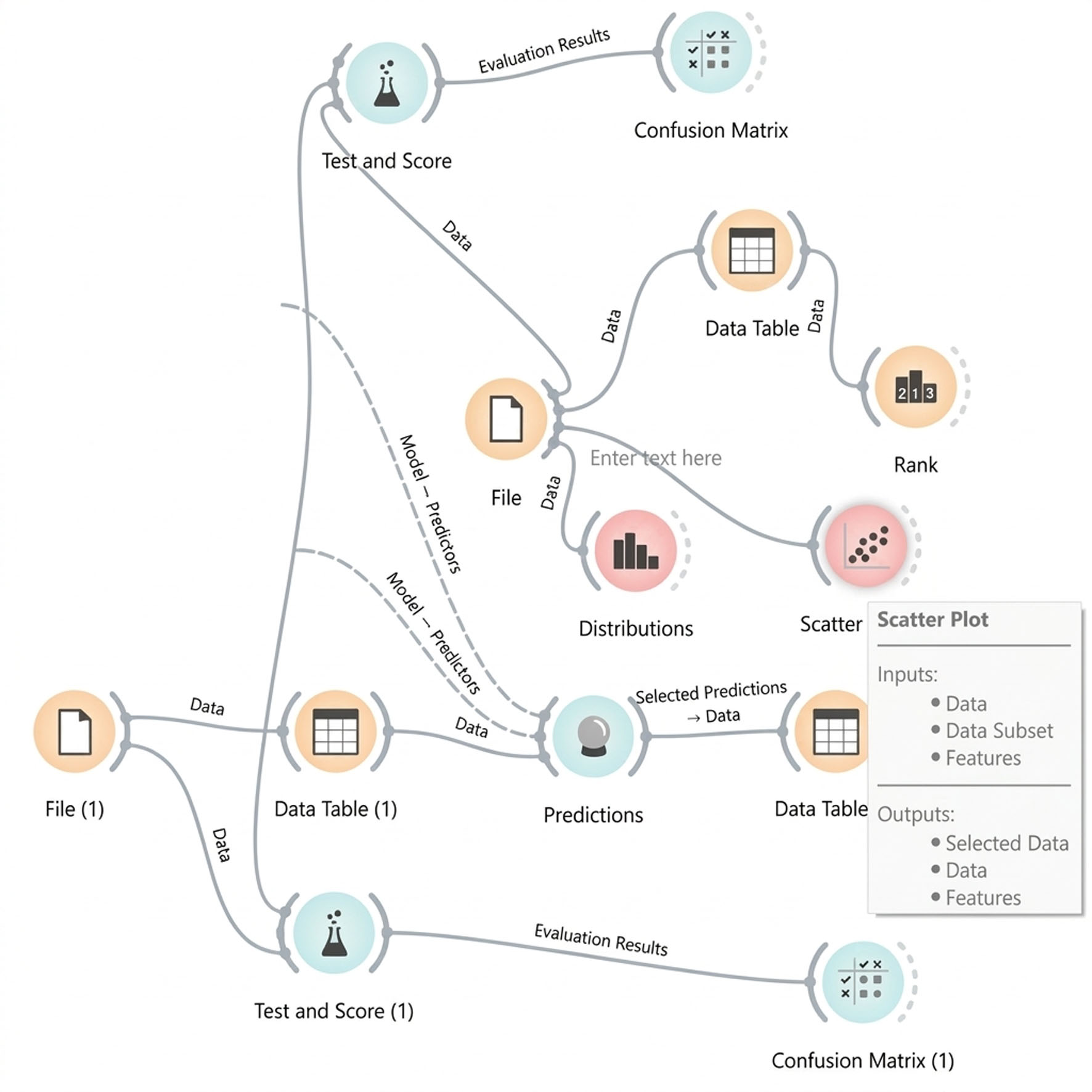
Methods: A retrospective analysis of 1,421 patient records from a public Kaggle dataset was conducted in Orange Data Mining to classify instances as healthy (class 0) or iron-deficient (class 1). Models were evaluated using leave-one-out (LOO) cross-validation applied to parametric logistic regression and a non-parametric decision tree. Evaluation metrics included area under the ROC curve (AUC), classification accuracy (CA), F1-score, precision, recall, and Matthews correlation coefficient (MCC).
Results: The dataset included 794 normal individuals and 627 iron-deficient patients. Logistic regression outperformed the decision tree, achieving a superior AUC (0.909 vs. 0.821), CA (0.834 vs. 0.816), and MCC (0.664 vs. 0.626). Confusion matrix analysis showed that logistic regression had higher sensitivity, correctly identifying 82.0% of iron-deficient cases compared to 77.4% by the decision tree.
Conclusion: A logistic regression model trained on basic CBC indices provides a highly accurate, sensitive, and computationally inexpensive tool for iron deficiency screening, holding significant promise for automated laboratory triage.
Published
Issue
Section
License
Copyright (c) 2026 The authors

This work is licensed under a Creative Commons Attribution 4.0 International License.