| AI in Clinical Medicine, ISSN 2819-7437 online, Open Access |
| Article copyright, the authors; Journal compilation copyright, AI Clin Med and Elmer Press Inc |
| Journal website https://aicm.elmerpub.com |
Review
Volume 2, April 2026, e18
Artificial Intelligence Applications in Pediatric Obesity Medicine: Bridging Predictive Analytics, Clinical Decision Support, and Family-Centered Care
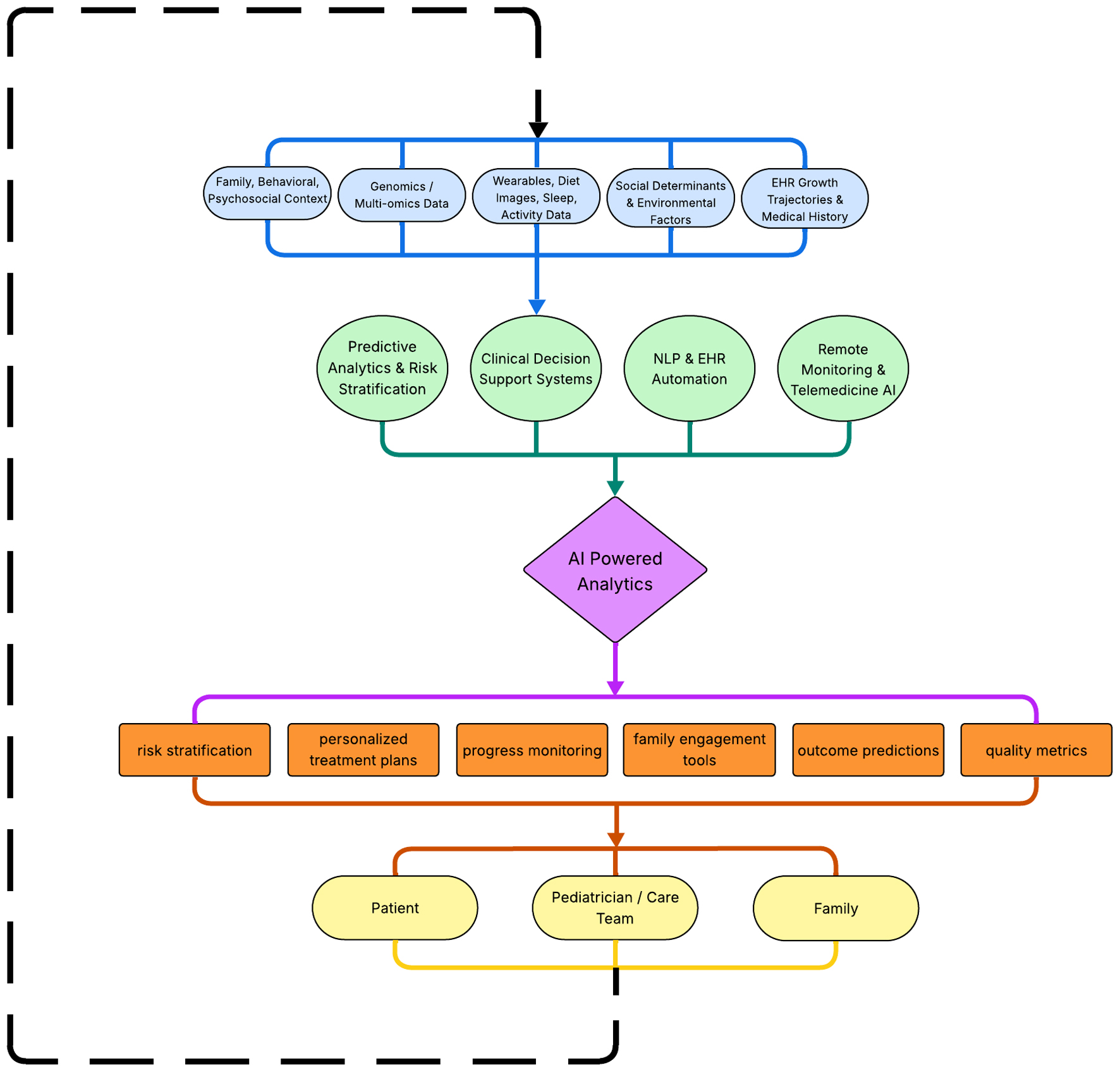
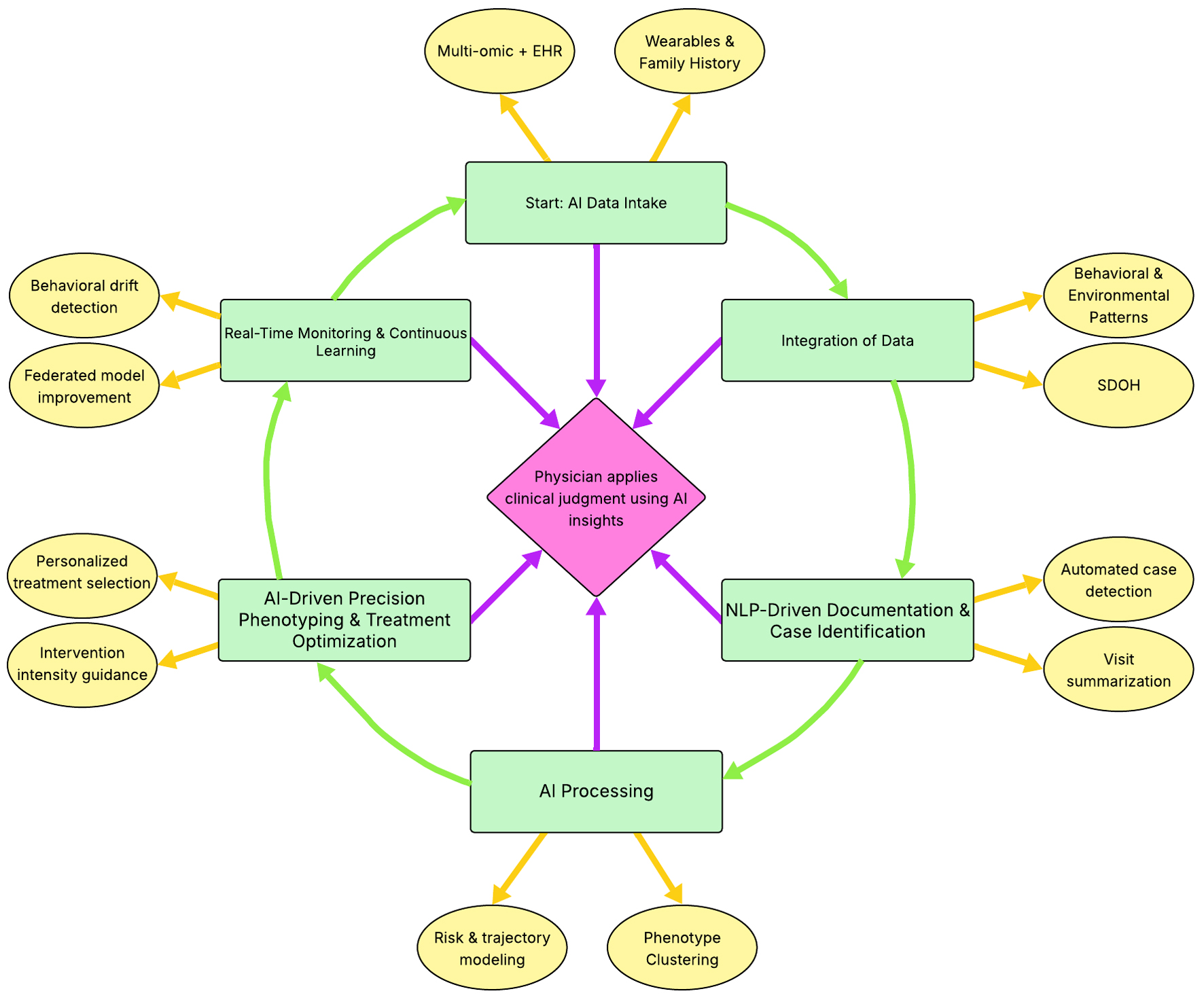
Figures


Tables
| AI domain | Current applications | Implementation status |
|---|---|---|
| This table summarizes key AI applications across predictive analytics, clinical decision support, remote monitoring, and natural language processing domains, including representative studies, technology approaches, reported performance metrics, and implementation status. Source: Table synthesized by authors JP, MS, and VSC from data extracted from [11, 12, 16–20]. Literature coverage: 2015–2024. AI: artificial intelligence. | ||
| Predictive analytics stage | Early obesity-risk prediction, analysis of growth trajectories | Research, early pilots, e.g., Esteva et al [12] demonstrated deep learning approaches; Ward et al [11] modeled childhood-to-adult obesity trajectories. |
| Clinical decision support phase (testing) | Treatment planning assistance, guideline-support prompts | Early pilots, limited clinical testing, e.g., Barlow et al [17] expert committee framework; Sutton et al [16] CDSS overview |
| Remote monitoring (apps) | Wearable analytics, diet tracking | Growing use, commercially available, e.g., Nahum-Shani et al [18] JITAI framework; Boushey et al [19] image-based dietary assessment. |
| Natural language processing adoption (studies) | Identification of obesity cases, documentation aid | Early pilots, e.g., Kreimeyer et al [20] NLP systems for clinical information extraction. |
| Challenge | Key impact | Solutions |
|---|---|---|
| This table categorizes major challenges to AI implementation, including technical, clinical, ethical, and equity-related barriers, along with evidence-based strategies and best practices for addressing each challenge category. Source: Table synthesized by authors JP, MS, and VSC from data extracted from [21–23]. AI: artificial intelligence; EHR: electronic health record. | ||
| Algorithmic bias (datasets and testing) | Inaccurate predictions for minorities/underserved groups | Use diverse datasets, fairness/bias testing |
| Data privacy (learning) | Compliance issues, trust concerns | Strong encryption, avoid sharing raw data |
| Interpretability (AI interfaces) | Reduced provider confidence, slower adoption due to “black box” outputs | Use explainable AI models, improve interface clarity |
| Workflow Integration (EHR integration) | Tools can disrupt workflow → increased clinical work | User-centered design, better operability with EHR platforms |
| Health equity (programs and adaptation) | Digital divide, risk of widening existing disparities | Expand technology access, culturally responsive AI design |