| AI in Clinical Medicine, ISSN 2819-7437 online, Open Access |
| Article copyright, the authors; Journal compilation copyright, AI Clin Med and Elmer Press Inc |
| Journal website https://aicm.elmerpub.com |
Original Article
Volume 2, April 2026, e20
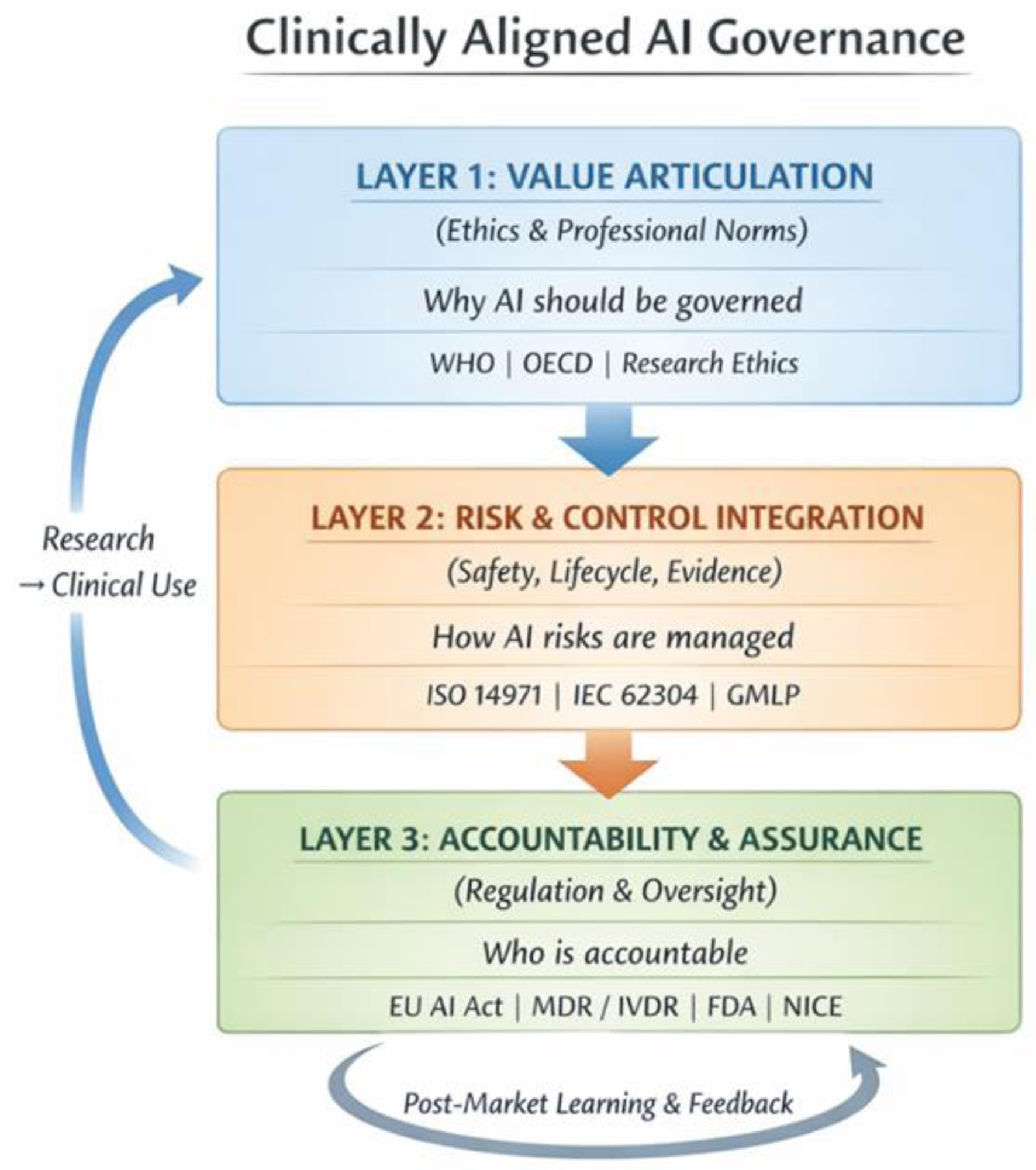
Clinically Aligned AI Governance: Integrating Ethics, Risk, and Regulation in Healthcare
Figure

Tables
| Framework | Type | Core focus | Strengths | Limitations |
|---|---|---|---|---|
| Summary of the most widely referenced cross-sector AI governance frameworks, including their type, core focus, strengths, and limitations in the context of healthcare applications. | ||||
| OECD AI Principles (2019, rev. 2024) [18] | Global policy principles | Human-centered values, transparency, robustness, accountability | Widely adopted; foundation for national strategies | High-level; voluntary |
| Montréal Declaration (2018) [19] | Ethical charter | Societal values and public engagement | Normative legitimacy | No enforcement |
| IEEE 7000 Series (2021) [20] | Technical standards | Ethics-by-design | Operationalizes values | Not legally binding |
| AIGA Framework (2022) [21] | Governance and auditing model | Linking principles to controls | Bridges legal, ethical, technical domains | Requires mature management systems |
| ISO/IEC 42001:2023 [22] | Management system standard | Enterprise AI governance | Certifiable; institutional accountability | Risk of formalistic compliance |
| NIST AI RMF (2023) [23] | Risk management framework | Lifecycle risk governance | Flexible and iterative | Voluntary |
| EU AI Act (2024) [24] | Binding regulation | Risk-based compliance | Strong enforcement | High implementation complexity |
| Framework category | Representative frameworks | Primary function | What it does not do |
|---|---|---|---|
| Classification of AI governance frameworks by their primary functional role: ethical/normative frameworks that establish legitimacy and values; risk and organizational methods that translate values into controls; and management and legal instruments that institutionalize accountability and enforcement. | |||
| Ethical/normative | OECD AI Principles; Montréal Declaration; WHO AI Ethics | Establish legitimacy, values, and expectations | Define clinical safety thresholds or enforce practice |
| Risk and organizational methods | IEEE 7000 Series; NIST AI RMF; AIGA Framework | Translate values into risk identification, controls, and documentation | Substitute for clinical governance |
| Management and legal instruments | ISO/IEC 42001; EU AI Act; MDR/IVDR | Institutionalize roles, auditability, and enforcement | Govern bedside clinical decisions |
| Clinical use case | Primary risks | Key standards | Governance focus |
|---|---|---|---|
| Mapping of primary AI-related risks, applicable governance standards, and governance focus areas across five key clinical AI deployment contexts: AI as medical device, clinical decision support, clinical research AI, molecular/genomic AI, and adaptive AI systems. Superscript letters (a–g) refer to footnotes describing the relevant international standards. aISO 14971: Standard for risk management of medical devices across the lifecycle. bIEC 62304: Standard for safe lifecycle management of medical device software. cISO/IEC 82304-1: Requirements for safety and quality of health software products. dISO 9241: Standards on usability and human-centred design of interactive systems. eDeclaration of Helsinki: Ethical principles for medical research involving human participants. fICH-GCP: International standard for ethical and scientific conduct of clinical trials. gPCCPs: Regulatory approach for controlled post-deployment changes to machine learning medical devices. | |||
| AI as medical device | Patient harm, drift | ISO 14971a; IEC 62304b; GMLP | Safety, traceability |
| Clinical decision support | Over-reliance, opacity | ISO/IEC 82304-1c; ISO 9241d; NIST AI RMF | Human oversight |
| Clinical research AI | Bias, invalid inference | Declaration of Helsinkie; ICH-GCPf; OECD Health Data | Research integrity |
| Molecular/genomic AI | Reproducibility, misuse | Domain bioinformatics standards; NIST AI RMF | Scientific validity |
| Adaptive AI systems | Drift, inequity | GMLP; PCCPsg | Continuous oversight and learning |