Figures
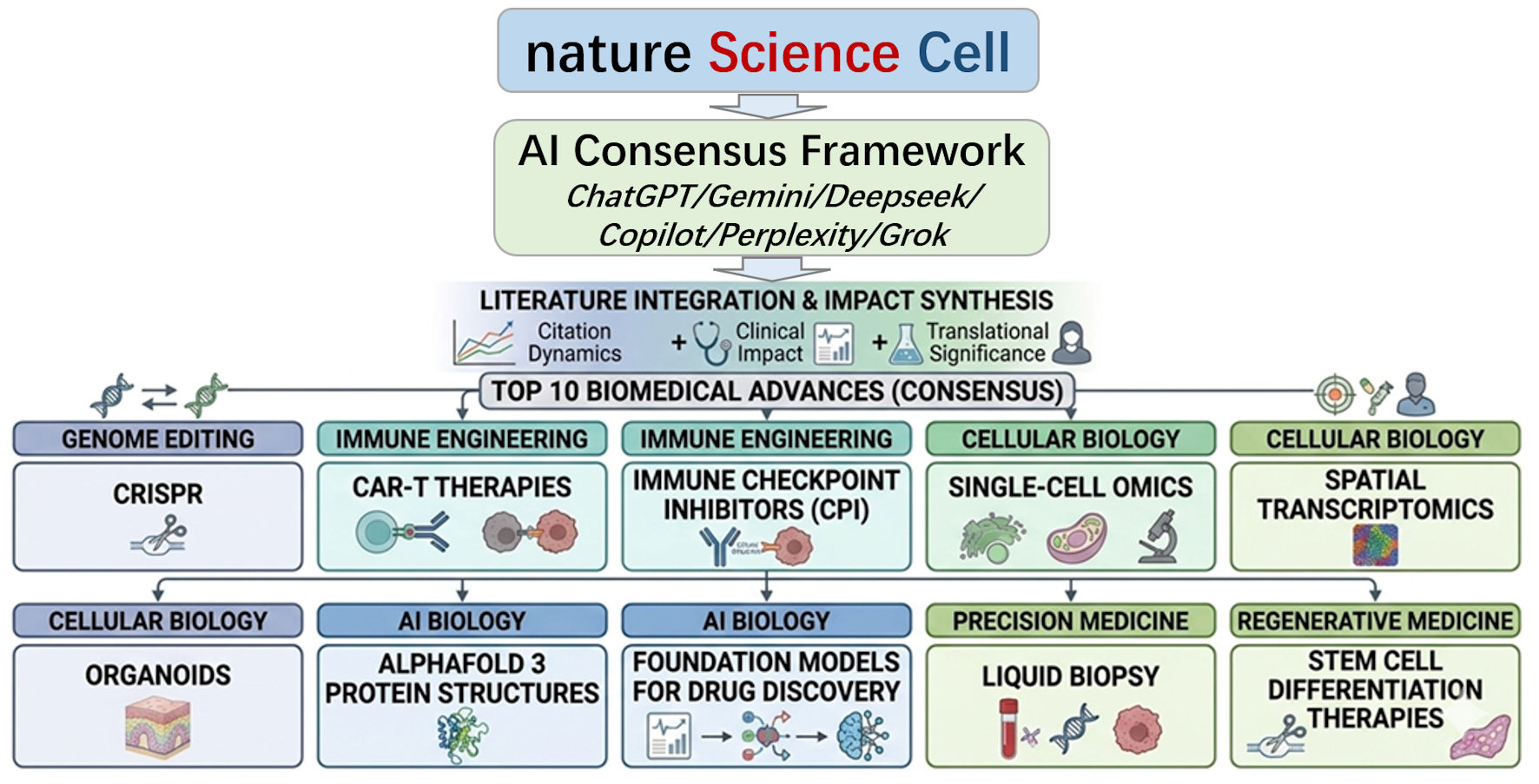
↓ Figure 1. Multi-platform AI consensus framework for the systematic identification and categorization of decade-defining biomedical advances. The schematic workflow illustrates the structured, multi-tier computational and analytical pipeline utilized to synthesize high-impact life science literature into key translational discoveries. Journal input and filtration: The baseline data repository is established by aggregating literature from the premier, high-impact multidisciplinary and basic science journals: Nature, Science, and Cell. AI consensus framework: To mitigate individual model bias, hallucination, and database variations, six state-of-the-art large language models (LLMs)—ChatGPT, Gemini, DeepSeek, Copilot, Perplexity, and Grok—are deployed in parallel to screen the publication landscape. Literature integration and impact synthesis: Extracted candidate breakthroughs undergo comprehensive multi-parametric scoring based on three distinct thematic axes: citation dynamics (academic velocity and propagation metrics), clinical impact (diagnostic/therapeutic utility and guideline integration), and translational significance (bench-to-bedside viability). Consensus taxonomy construction: Validated findings reaching the majority quorum are classified into five core biomedical pillars: (1) genome editing: anchored by CRISPR-based systems for precise therapeutic genomic modifications; (2) immune engineering: encompassing chimeric antigen receptor T-cell (CAR-T) therapies and checkpoint inhibitors (CPI); (3) cellular biology: integrating multi-scale spatial resolution platforms, including the Human Cell Atlas, single-cell sequencing, spatial omics, and stem cell-derived organoids; (4) AI biology: dominated by deep-learning architectures like AlphaFold for structural protein mapping and predictive proteomics; (5) precision medicine: epitomized by noninvasive liquid biopsy platforms for circulating tumor biomarker dynamics and early-stage disease interception. AI: artificial intelligence; CRISPR: clustered regularly interspaced short palindromic repeats.
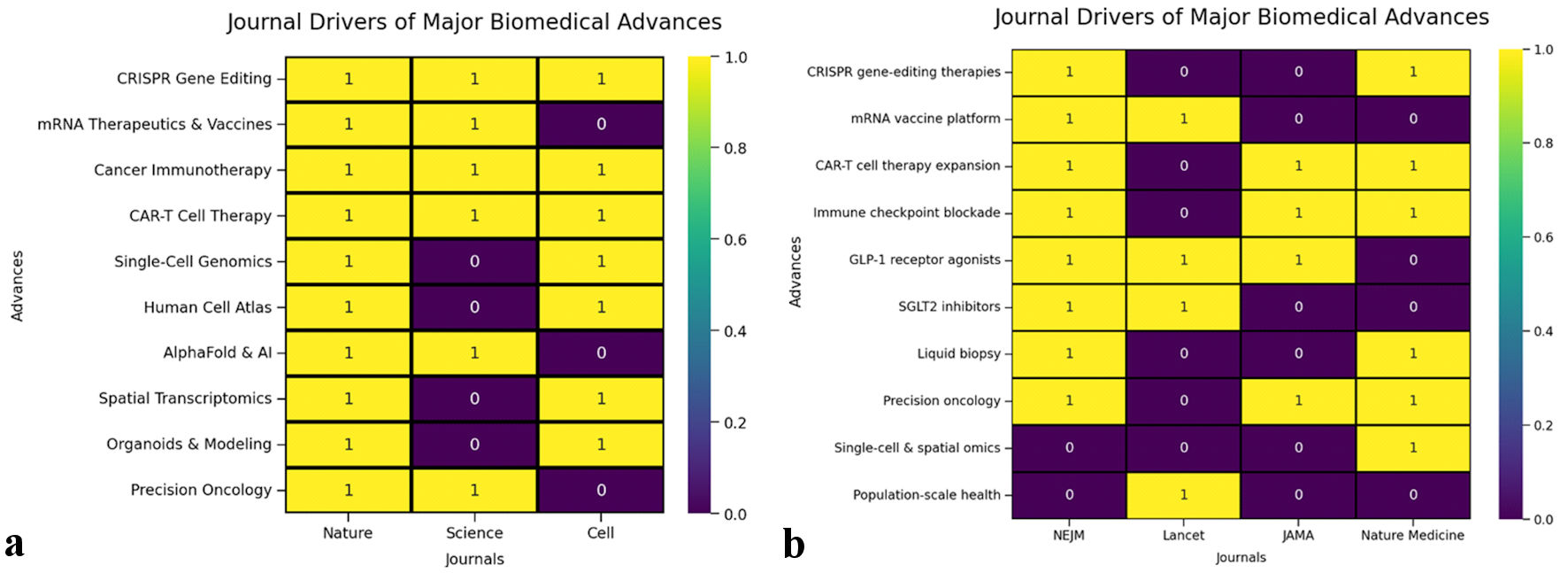
↓ Figure 2. Major biomedical advances mapped across leading discovery and clinical journals. (a) Heatmap showing the contribution of leading discovery journals (Nature, Science, Cell) to key biomedical advances over the past decade. (b) Heatmap showing the evidence base from major clinical journals (New England Journal of Medicine (NEJM), The Lancet, JAMA, Nature Medicine) for the same advances. In both panels, cells are binary-coded (1, positive contribution; 0, limited contribution). Together, the heatmaps illustrate complementary roles across journals, with strong convergence for major platforms such as CRISPR, cancer immunotherapy, and cardiometabolic therapies, and domain-specific specialization spanning fundamental discovery, mechanistic insight, and clinical translation. CRISPR: clustered regularly interspaced short palindromic repeats; CAR-T: chimeric antigen receptor T-cell; GLP-1: glucagon-like peptide-1; SGLT2: sodium-glucose cotransporter 2.
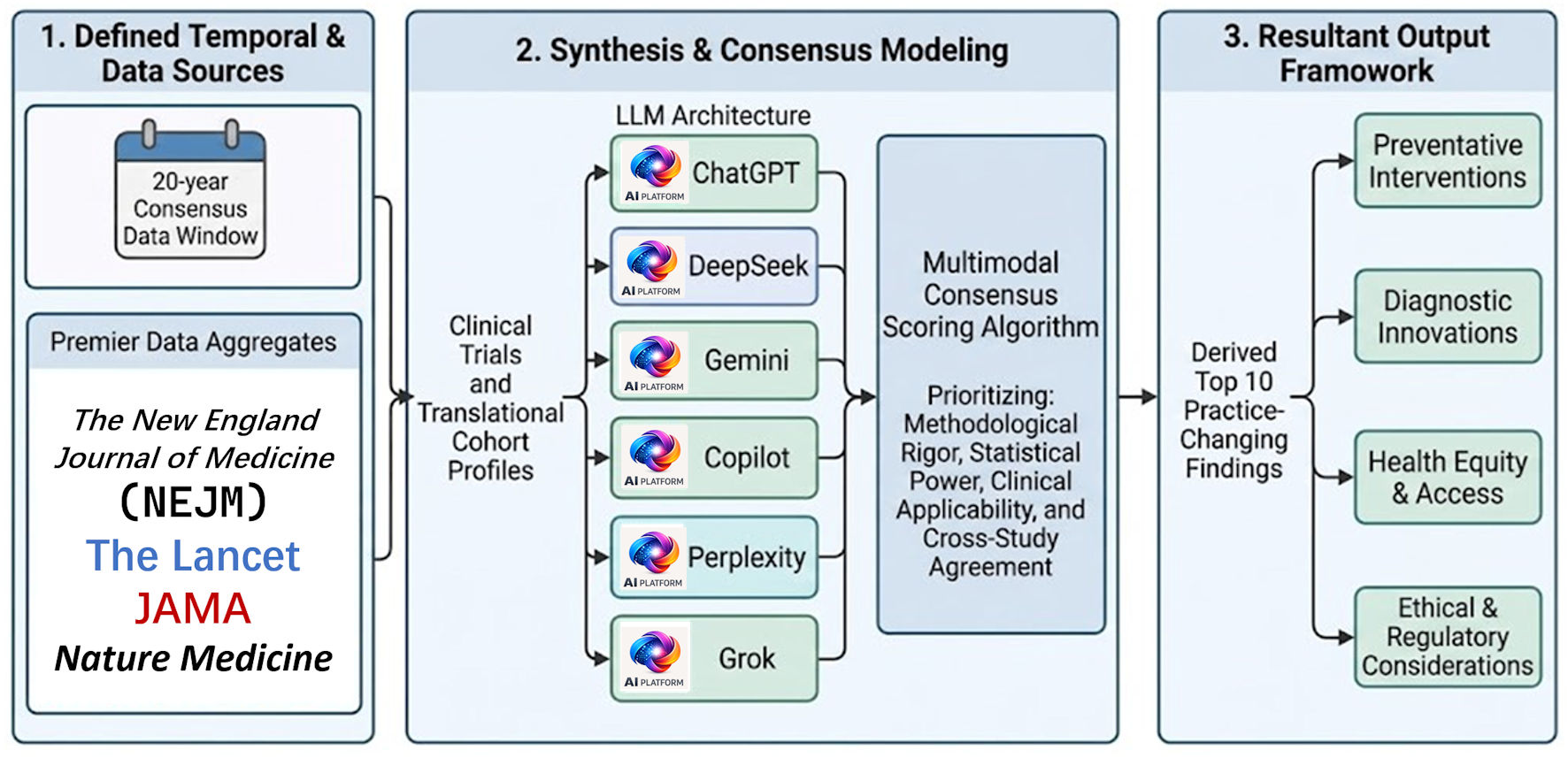
↓ Figure 3. Methodological pipeline for multi-AI evaluation of clinical evidence frameworks. This schematic illustrates the three-stage algorithmic pipeline used to ingest, evaluate, and categorize high-impact clinical evidence published over the past decade. Temporal window and source journals (data ingestion): Data inputs are strictly constrained to a longitudinal 10-year publication window. Source literature is derived exclusively from the premier clinical and translational databases, including the New England Journal of Medicine (NEJM), The Lancet, JAMA, and Nature Medicine. Extracted data matrices comprise comprehensive clinical trials and translational cohort profiles. Evaluation and scoring layers (parallel large language model (LLM) processing): Ingested profiles are processed asynchronously and in parallel across six independent LLM architectures: ChatGPT, DeepSeek, Gemini, Copilot, Perplexity, and Grok. Independent AI-generated evaluation metrics are subsequently integrated via a standardized consensus scoring model. The consensus framework is mathematically weighted to prioritize three core clinical vectors: real-world clinical impact, citation kinetics (bibliometric velocity), and practice-changing potential. Output taxonomy (downstream mapping): The pipeline resolves into the top 10 consensus findings based on cumulative algorithmic ranking. These definitive insights are systematically branched and mapped onto four vital pillars of modern medicine: therapeutics, precision medicine, cellular biology, and population health. AI: artificial intelligence.
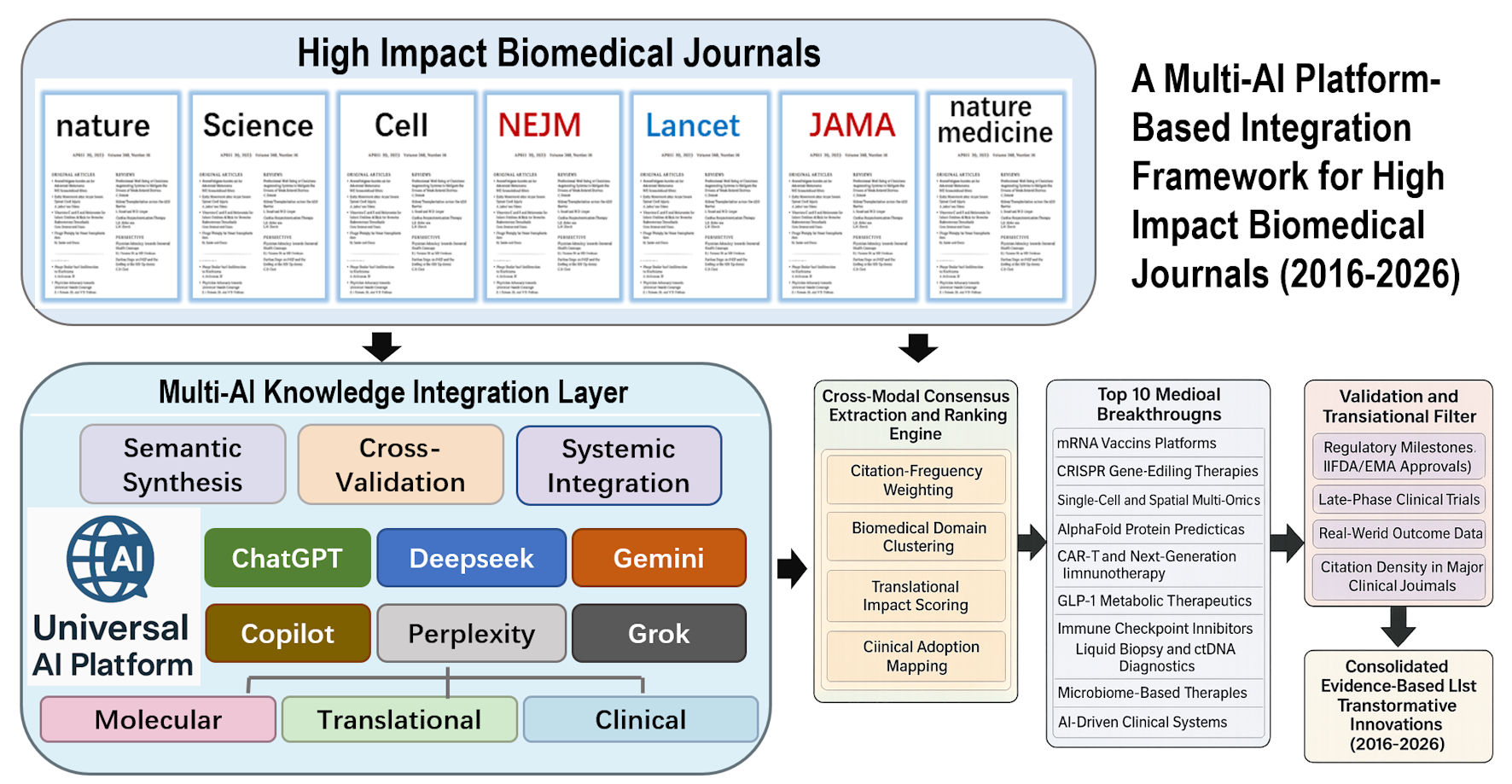
↓ Figure 4. High-impact biomedical journal integration framework (2016–2026). Schematic overview of the multi-layered, AI-driven pipeline utilized to identify, aggregate, and validate the decade’s most influential medical breakthroughs. The upper tier integrates data ingestion from seven leading biomedical journals (Nature, Science, Cell, New England Journal of Medicine (NEJM), The Lancet, JAMA, and Nature Medicine) serving as the primary literature sources. The multi-AI knowledge integration layer synthesizes these data by executing semantic synthesis, cross-validation, and cross-domain clustering of high-impact findings across molecular, translational, and clinical domains using six advanced large language models (ChatGPT, DeepSeek, Gemini, Copilot, Perplexity, and Grok). Downstream processing by the Cross-Modal Consensus Extraction and Ranking Engine scores these findings based on citation-frequency weighting, domain clustering, translational impact, and clinical adoption mapping to generate a prioritized consensus list. This pipeline identifies the Top 10 Medical Breakthroughs—ranging from mRNA vaccine platforms and CRISPR therapies to AlphaFold protein prediction and AI-driven clinical systems. Finally, candidates pass through a rigorous Validation and Translational Filter evaluating regulatory milestones (FDA/EMA approvals), late-phase clinical trial data, real-world outcomes, and clinical citation density to yield a consolidated, evidence-based list of transformative innovations spanning 2016 to 2026. Arrows indicate the directional flow of data synthesis, evaluation, and empirical validation. AI: artificial intelligence; CRISPR: clustered regularly interspaced short palindromic repeats; FDA: US Food and Drug Administration; EMA: European Medicines Agency.
Tables
↓ Table 1. Consensus Top 10 Medical Science Advances (Nature + Science + Cell)
| Rank | Biomedical advance | Major journals | Medical impact |
|---|
| CRISPR: clustered regularly interspaced short palindromic repeats; CAR-T: chimeric antigen receptor T-cell; COVID-19: coronavirus disease 2019. |
| 1 | CRISPR gene editing | Nature, Science, Cell | First programmable genome engineering platform |
| 2 | mRNA therapeutics and vaccines | Nature, Science | COVID-19 vaccines and next-generation therapeutics |
| 3 | Cancer immunotherapy (checkpoint blockade) | Nature, Science, Cell | Durable responses across multiple cancers |
| 4 | CAR-T cell therapy | Science, Nature, Cell | Curative potential for hematologic malignancies |
| 5 | Single-cell genomics | Cell, Nature | Cellular-resolution disease biology |
| 6 | Human Cell Atlas | Nature, Cell | Comprehensive reference map of human cells |
| 7 | AlphaFold and AI for biology | Nature, Science | Revolutionized protein structure prediction and drug discovery |
| 8 | Spatial transcriptomics | Nature, Cell | Molecular mapping directly within tissues |
| 9 | Organoids and human disease modeling | Nature, Cell | Human-relevant models replacing many animal studies |
| 10 | Precision oncology and liquid biopsy | Nature, Science | Earlier detection and personalized treatment |
↓ Table 2. Consensus Top 10 Medical Advances (NEJM + Lancet + JAMA + Nature Medicine)
| Rank | Biomedical advance | Major journals | Medical impact |
|---|
| CRISPR: clustered regularly interspaced short palindromic repeats; CAR-T: chimeric antigen receptor T-cell; ctDNA: circulating tumor DNA; GLP-1: glucagon-like peptide-1; SGLT2: sodium-glucose cotransporter 2; cfDNA: cell-free DNA; GBD: Global Burden of Disease; HPV: human papillomavirus; MRD: minimal residual disease; NEJM: New England Journal of Medicine. |
| 1 | CRISPR gene-editing therapies | NEJM, Nature Medicine | First-in-human curative genome editing (e.g., sickle cell disease) |
| 2 | mRNA vaccine platform | NEJM, Lancet | Rapid, scalable vaccine design; infectious disease + oncology applications |
| 3 | CAR-T cell therapy expansion | NEJM, Nature Medicine, JAMA | Transformative hematologic cancer remission; solid tumor expansion ongoing |
| 4 | Immune checkpoint blockade | NEJM, JAMA, Nature Medicine | Durable tumor regression across multiple cancers |
| 5 | GLP-1 receptor agonists (semaglutide class) | NEJM, Lancet, JAMA | Paradigm shift in obesity, diabetes, and cardiovascular risk reduction |
| 6 | SGLT2 inhibitors in cardio-renal disease | NEJM, Lancet | New standard for heart failure and chronic kidney disease |
| 7 | Liquid biopsy (ctDNA/cfDNA diagnostics) | NEJM, Nature Medicine | Noninvasive cancer detection, MRD monitoring, early recurrence detection |
| 8 | Precision oncology (genomics-guided therapy) | NEJM, JAMA, Nature Medicine | Tissue-agnostic, mutation-driven cancer treatment strategies |
| 9 | Single-cell and spatial omics technologies | Nature Medicine | Cellular-resolution mapping of tumor, immune, and tissue ecosystems |
| 10 | Population-scale health transformation (GBD, HPV elimination, climate-health) | Lancet | Global prevention frameworks and health system redesign |