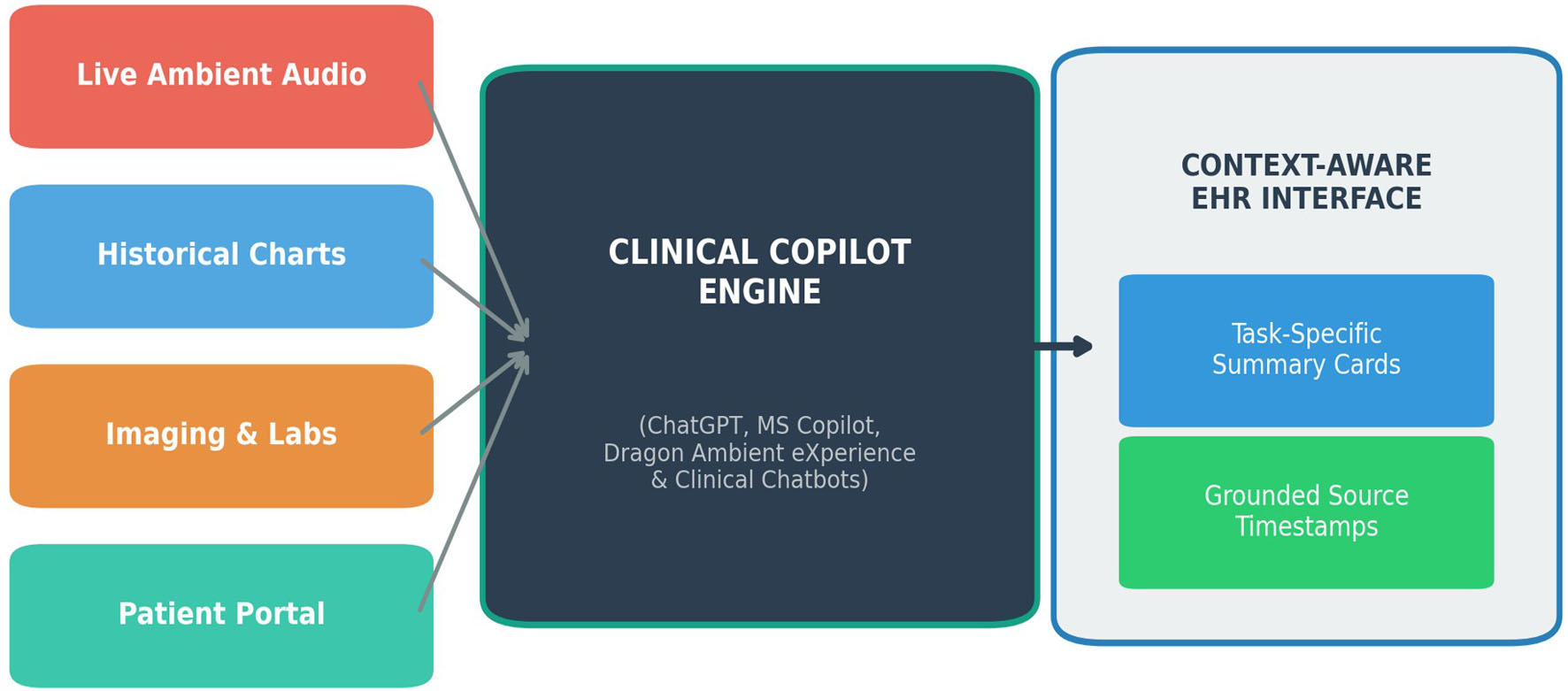
↓ Figure 1. Multimodal data fusion architecture with AI agents (Microsoft Copilot, ChatGPT, & Clinical Chatbots).
| AI in Clinical Medicine, ISSN 2819-7437 online, Open Access |
| Article copyright, the authors; Journal compilation copyright, AI Clin Med and Elmer Press Inc |
| Journal website https://aicm.elmerpub.com |
Review
Volume 2, August 2026, e35
Optimizing the Use of AI Agents in Electronic Health Record Workflows in Healthcare: Clinical Integration and Human Factors Review
Figures
Tables
| Feature/dimension | Ambient Scribes (Abridge/DAX) | Microsoft Copilot for Healthcare | ChatGPT (OpenAI Enterprise) | Specialized clinician chatbots |
|---|---|---|---|---|
| Primary clinical focus | Passive ambient consultation recording & SOAP note generation. | EHR chart summarization, inbox draft synthesis, & Microsoft 365 workflow automation. | General conversational reasoning, patient letter generation, & complex differential query support. | Interactive chart QA, clinical protocol retrieval, & real-time decision support. |
| Interaction mechanism | Background microphone audio capture (hands-free). | Sidebar EHR pane & embedded native buttons. | Conversational chat window/API integration. | Interactive chat interface embedded in EHR. |
| HIPAA/data privacy | BAA compliant, audio processed in HIPAA enclave. | Enterprise HIPAA compliance via Azure Health Data Services. | Enterprise BAA required; zero data retention for training. | Dedicated HIPAA-compliant clinical infrastructure. |
| Primary strengths | Eliminates manual typing during patient encounters. | Seamless deep integration with Epic, Cerner, and Office 365. | Superior complex reasoning, multi-language translation, & drafting flexibility. | High precision on domain-specific medical guidelines & literature. |
| Key HFE & Usability risks | Acoustic distortion in noisy rooms; verification fatigue. | Context switching if integrated across multiple sidebar tabs. | Risk of ungrounded hallucinations if prompt isn’t tied to RAG. | Alert fatigue and chat friction if answers are verbose. |
| Workflow dimension | Legacy EHR workflow | AI agent & Copilot workflow |
|---|---|---|
| Documentation | Manual typing/dictation during or post-encounter. | Real-time ambient capture with DAX/MS Copilot notes drafting. |
| Chart review | 5–15 min spent navigating fragmented tabs. | Conversational clinical chatbot queries and single-page LLM summaries. |
| In-basket triage | First-in, first-out manual review of all messages. | Automated urgency routing + MS Copilot generative draft response. |
| Safety alerts | High-volume, static pop-ups leading to alert fatigue. | Targeted, risk-calculated predictive CDS interventions. |
| Prior auth/coding | Labor-intensive manual chart data extraction. | Automated MS Copilot evidence extraction matched to payer rules. |
| Performance metric | Pre-AI baseline | Post-AI agent implementation | Operational shift (%) |
|---|---|---|---|
| Documentation time (per patient) | 10–12 min | 2–4 min | 75% reduction |
| Daily administrative time (per FTE) | 2.5 h | 1.0 hour | 60% reduction |
| After-hours (weekly) | 8–10 h | 2–3 h | 70% reduction |