| AI in Clinical Medicine, ISSN 2819-7437 online, Open Access |
| Article copyright, the authors; Journal compilation copyright, AI Clin Med and Elmer Press Inc |
| Journal website https://aicm.elmerpub.com |
Review
Volume 1, 2025, e8
The Role of Artificial Intelligence in Accelerating Drug Discovery and Development
Figures


Tables
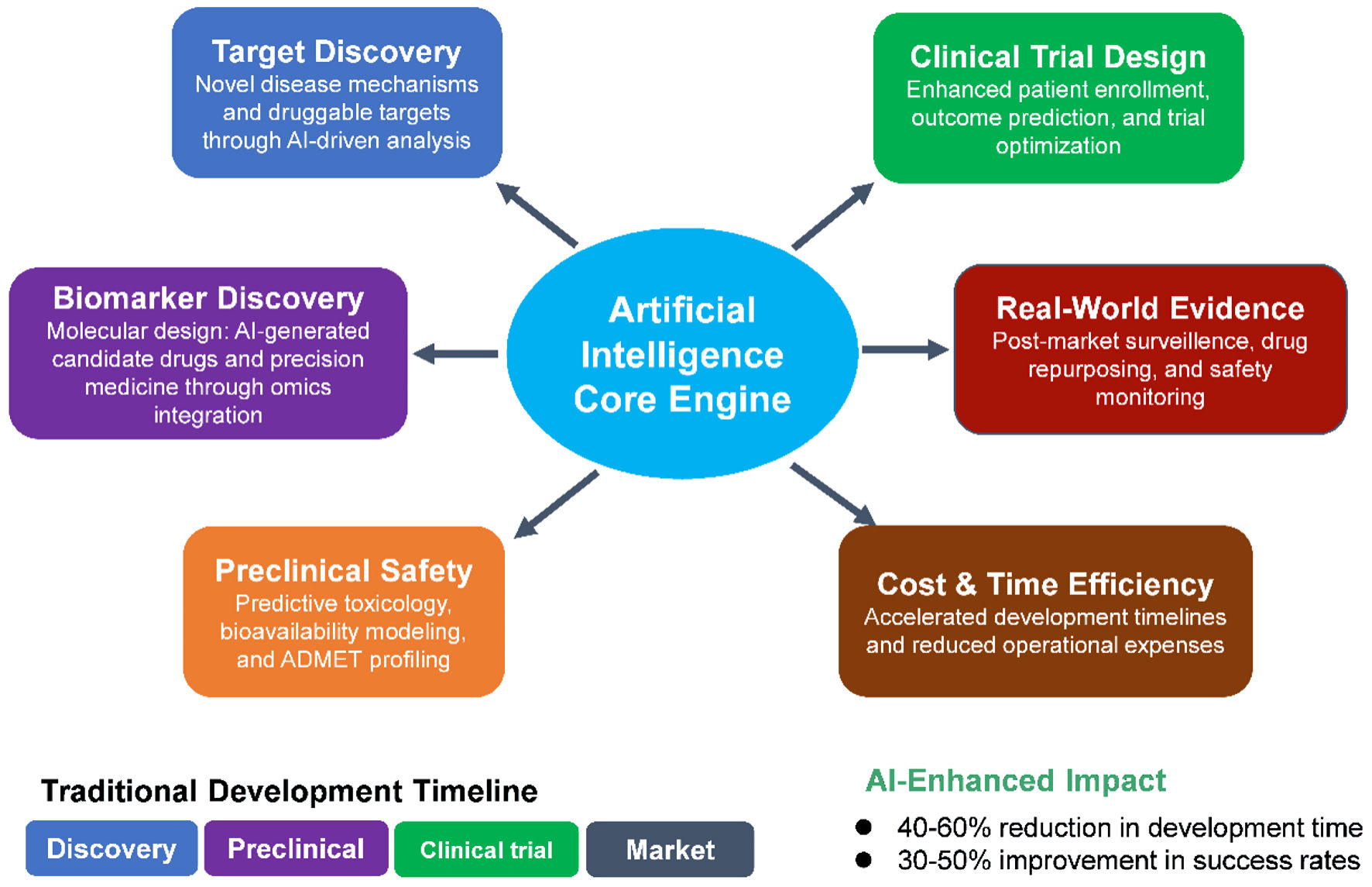
| Stage | AI applications |
|---|---|
| AI: artificial intelligence; R&D: research and development; ADMET: absorption, distribution, metabolism, excretion, and toxicity; EHRs: electronic health records. | |
| Target identification | Analyzes omics data and literature to find and validate disease-relevant targets |
| Speeds up discovery of novel and druggable targets | |
| Hit discovery | Screens virtual compound libraries, predicts binding affinities, de novo design |
| Rapid identification of candidate molecules | |
| Lead optimization | Models structure-activity relationships (SAR), predicts ADMET properties, suggests synthetic pathways |
| Improves efficacy, reduces toxicity, enhances developability | |
| Preclinical modeling | Predicts in vivo outcomes, toxicity, and off-target effects |
| Enhances animal model selection and safety profiling | |
| Biomarker discovery | Extracts predictive and prognostic biomarkers from multi-modal data |
| Enables precision medicine and better patient stratification | |
| Clinical trial design | Selects optimal patient cohorts, predicts outcomes, designs adaptive trials |
| Increases trial efficiency and success rates | |
| Real-world evidence | Analyzes EHRs, registries, and wearable data |
| Improves post-market surveillance and supports drug repurposing | |
| Cost and time reduction | Automates processes, reduces lab and trial failures |
| Shortens development timelines and lowers overall R&D costs | |
| Stage of drug R&D | AI applications |
|---|---|
| AI: artificial intelligence; R&D: research and development; ADMET: absorption, distribution, metabolism, excretion, and toxicity; EHRs: electronic health records; COVID-19: coronavirus disease 2019. | |
| Target identification | Analyzes genomics/proteomics data |
| Predicts protein structures (e.g., AlphaFold) | |
| Prioritizes high-value targets | |
| Drug discovery | Generative AI designs novel molecules |
| Virtual screening (e.g., Schrodinger) | |
| De novo drug design (e.g., Insilico Medicine) | |
| Preclinical testing | Predicts ADMET (toxicity/safety) |
| AI-driven lab automation (robotics) | |
| Reduces animal testing | |
| Clinical trials | AI matches patients using EHRs |
| Predicts trial success/failure | |
| Monitors adverse effects in real time | |
| Drug repurposing | Identifies new uses for existing drugs (e.g., baricitinib for COVID-19) |
| Saves time/resources vs. developing new drugs | |
| Manufacturing | Optimizes production with predictive AI |
| AI forecasts supply chain demands | |
| Reduces waste and ensures consistent drug supply | |
| Stage | AI applications |
|---|---|
| AI: artificial intelligence; R&D: research and development. | |
| Target identification | Analyzes genomics/proteomics data to identify novel drug targets with high precision |
| Drug design | Predicts molecular interactions to design compounds with optimal binding properties |
| Virtual screening | Screens millions of compounds in silico to identify candidates, reducing experimental costs |
| Predictive toxicology | Assesses toxicity and side effects early, minimizing late-stage clinical trial failures |
| Clinical trial optimization | Improves patient recruitment and predicts outcomes, streamlining trial design |
| Repurposing drugs | Identifies new uses for existing drugs, accelerating development for new indications |
| Personalized medicine | Tailors treatments using patient data, speeding up precision therapy development |
| Automation of data analysis | Processes complex datasets (imaging, chemical, clinical), reducing errors and manual effort |
| Synthesis prediction | Predicts optimal chemical synthesis routes, minimizing iterations and costs |
| Regulatory support | Streamlines documentation and predicts regulatory outcomes, speeding up submissions |
| Stage | AI application |
|---|---|
| AI: artificial intelligence; R&D: research and development. | |
| Identification of drug candidates | Speeds up discovery of potential compounds |
| Prediction of drug properties and safety | Improves accuracy in forecasting efficacy, toxicity, and interactions |
| Optimization of preclinical and clinical trials | Streamlines trial design, patient recruitment, monitoring, and outcome prediction |
| Integration of experimental feedback (“lab in the loop”) | Enables iterative refinement of drug candidates using AI and lab data |
| Cost and time reduction | Significantly lowers R&D expenses and shortens development timelines |
| Advanced structural biology | AI tools like AlphaFold predict protein structures, aiding targeted drug design |
| Drug repurposing | Identifies new therapeutic uses for existing drugs |
| Personalized medicine | Analyzes genomics, proteomics, and clinical data to tailor treatments |
| Generative AI for molecule design | Designs new molecular structures with desired properties |
| Higher success rates in clinical development | Increases probability of drug candidates progressing through clinical phases |
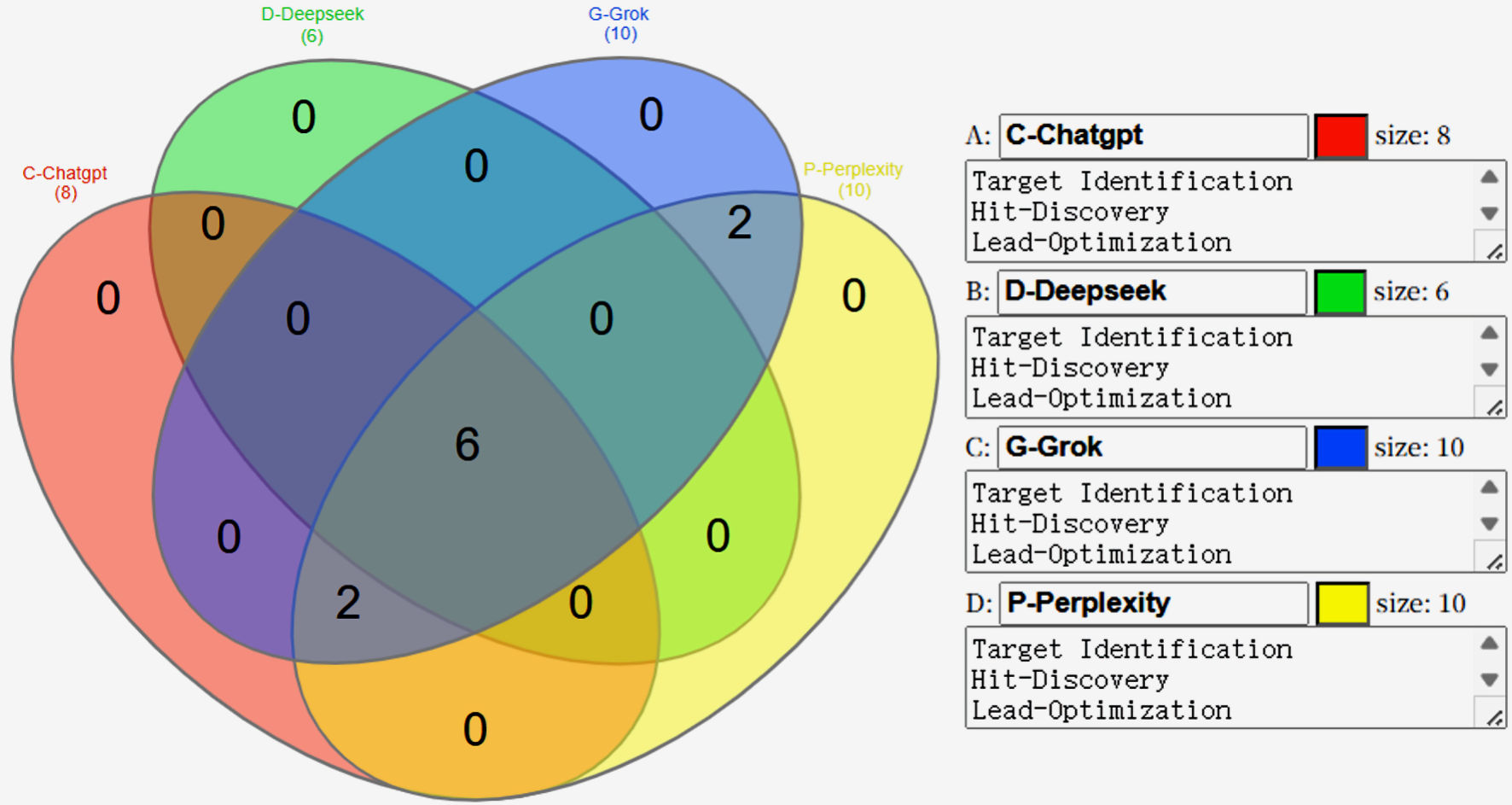
| Category | ChatGPT (C) | DeepSeek (D) | Grok (G) | Perplexity (P) |
|---|---|---|---|---|
| The table summarizes the outputs from four AI platforms, intended as an illustrative comparison of emphasis areas rather than a systematic analysis. AI: artificial intelligence. | ||||
| Target identification | Target identification | Target identification | Target identification | Identification of drug candidates |
| Hit discovery | Hit discovery | Drug discovery | Drug design | Prediction of drug properties and safety |
| Lead optimization | Lead optimization | Preclinical testing | Virtual screening | Optimization of preclinical and clinical trials |
| Preclinical modeling | Preclinical modeling | Clinical trials | Predictive toxicology | Integration of experimental feedback (“lab in the loop”) |
| Biomarker discovery | Biomarker discovery | Drug repurposing | Clinical trial optimization | Cost and time reduction |
| Clinical trial design | Clinical trial design | Manufacturing | Repurposing drugs | Advanced structural biology |
| Real-world evidence | Real-world evidence | - | Personalized medicine | Drug repurposing |
| Cost and time reduction | Cost and time reduction | - | Automation of data analysis | Personalized medicine |
| Molecular synthesis | - | - | Synthesis prediction | Generative AI for molecule design |
| Regulatory and success | - | - | Regulatory support | Higher success rates in clinical development |