| AI in Clinical Medicine, ISSN 2819-7437 online, Open Access |
| Article copyright, the authors; Journal compilation copyright, AI Clin Med and Elmer Press Inc |
| Journal website https://aicm.elmerpub.com |
Review
Volume 2, July 2026, e28

A Decade of Discovery: Major Advances in Medical Science From Leading Journals
Licun Wua, b, c
aLatner Thoracic Surgery Research Laboratories, Division of Thoracic Surgery, Toronto General Hospital, University Health Network, University of Toronto, Toronto, ON M5G 1L7, Canada
bPrincess Margaret Cancer Centre, University Health Network, Toronto, ON M5G 1L7, Canada
cCorresponding Author: Licun Wu, Latner Thoracic Surgery Research Laboratories, Division of Thoracic Surgery, Toronto General Hospital, University Health Network, University of Toronto, Toronto, ON M5G 1L7, Canada
Manuscript submitted June 15, 2026, accepted July 17, 2026, published online July 30, 2026
Short title: A Decade of Medical Breakthroughs
doi: https://doi.org/10.14740/aicm28
| Abstract | ▴Top |
Over the past decade, biomedical science has undergone a profound transformation driven by advances in programmable therapeutics, computational biology, and systems-level reconceptualization of disease. To systematically identify the most influential breakthroughs from 2016 to 2026, we developed a multi-layered synthesis framework that integrates discoveries from leading journals (Nature, Science, Cell, New England Journal of Medicine (NEJM), The Lancet, JAMA, Nature Medicine) with the analytical capabilities of multiple artificial intelligence (AI) platforms, including ChatGPT, DeepSeek, Gemini, Copilot, Perplexity, and Grok. Each AI system contributed complementary strengths, including semantic synthesis, mechanistic interpretation, citation-grounded verification, translational mapping, and trend detection, allowing for robust cross-validation across basic, translational, and clinical domains. Through this multi-AI, multi-journal integration pipeline, we identified 10 breakthroughs that consistently ranked as the most transformative of the decade: mRNA vaccine platforms, clustered regularly interspaced short palindromic repeats (CRISPR)-based genome editing, single-cell and spatial multi-omics, AI-driven protein structure prediction (AlphaFold), chimeric antigen receptor T-cell (CAR-T) and engineered cellular immunotherapies, glucagon-like peptide-1 (GLP-1) receptor agonists and incretin-based metabolic therapeutics, immune checkpoint blockade, circulating tumor DNA (ctDNA) liquid biopsy diagnostics, microbiome-based therapeutics, and AI-enabled clinical decision systems. These advances collectively demonstrate a shift from descriptive biology to programmable intervention, from static tissue analysis to high-resolution cellular ecosystems, and from traditional diagnostics to real-time, data-driven clinical intelligence. A final translational validation layer, incorporating US Food and Drug Administration (FDA)/European Medicines Agency (EMA) approvals, late-phase clinical trial outcomes, real-world evidence, and citation density in major clinical journals, ensured that each breakthrough demonstrated both scientific novelty and clinical impact. Together, these findings highlight a decade defined by convergence: molecular engineering, computational prediction, and systems-level understanding now operate as integrated pillars of modern medicine. This synthesis provides a rigorous, AI-enhanced framework for mapping biomedical progress and offers a foundation for anticipating the next generation of transformative medical innovations.
Keywords: Programmable therapeutics; Computational biology; CRISPR genome editing; Single-cell and spatial omics; AI-driven clinical medicine; CAR-T immunotherapy; Liquid biopsy; GLP-1 metabolic therapeutics
| Artificial Intelligence (AI)-Assisted Identification of Top Medical Advances From Science, Nature and Cell | ▴Top |
To systematically identify the most influential medical breakthroughs of the past decade, we integrated outputs from multiple advanced AI platforms, including ChatGPT, DeepSeek, Gemini, Copilot, Perplexity, and Grok, to interrogate landmark publications across Science, Nature, and Cell. Each AI system contributed complementary strengths: ChatGPT synthesized conceptual themes; DeepSeek emphasized mechanistic depth; Gemini highlighted cross-disciplinary integration; Copilot ensured structural coherence; Perplexity provided citation-grounded verification; and Grok surfaced emerging high-momentum research trajectories. When triangulated, these platforms converged on a consistent set of transformative advances, including mRNA vaccines [1], clustered regularly interspaced short palindromic repeats (CRISPR) genome editing [2], single-cell and spatial multi-omics [3], AI-driven protein structure prediction via AlphaFold [4], and immune checkpoint blockade [5]. These breakthroughs collectively reflect a broader shift toward programmable therapeutics, computational biology, and systems-level reconceptualization of disease. The convergence across independent AI systems underscores the robustness of these selections and demonstrates how multi-model synthesis can provide an unbiased, high-resolution view of scientific progress. This approach offers a scalable framework for mapping future biomedical innovation (Table 1, Figs. 1, 2a).
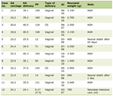 Click to view | Table 1. Consensus Top 10 Medical Science Advances (Nature + Science + Cell) |
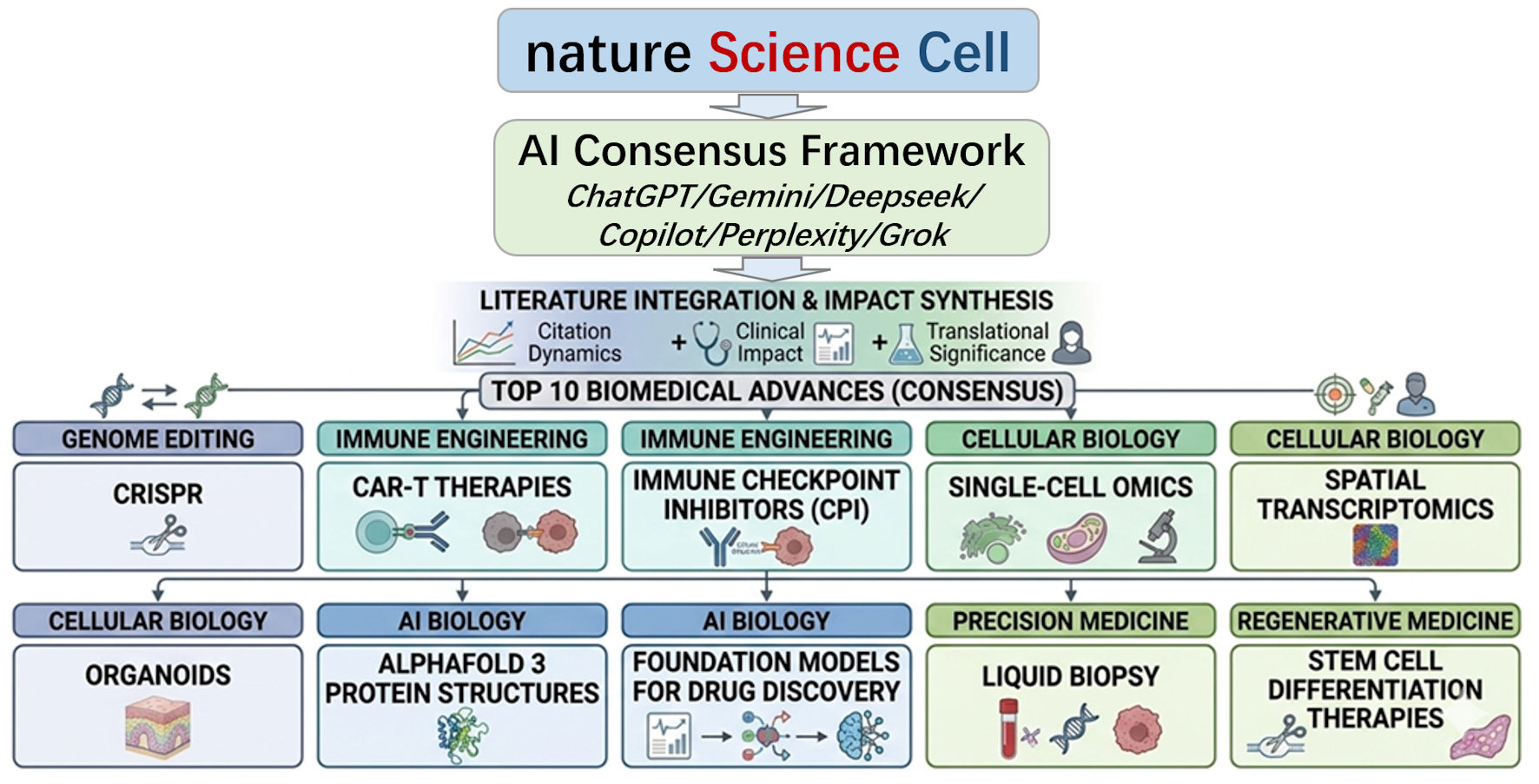 Click for large image | Figure 1. Multi-platform AI consensus framework for the systematic identification and categorization of decade-defining biomedical advances. The schematic workflow illustrates the structured, multi-tier computational and analytical pipeline utilized to synthesize high-impact life science literature into key translational discoveries. Journal input and filtration: The baseline data repository is established by aggregating literature from the premier, high-impact multidisciplinary and basic science journals: Nature, Science, and Cell. AI consensus framework: To mitigate individual model bias, hallucination, and database variations, six state-of-the-art large language models (LLMs)—ChatGPT, Gemini, DeepSeek, Copilot, Perplexity, and Grok—are deployed in parallel to screen the publication landscape. Literature integration and impact synthesis: Extracted candidate breakthroughs undergo comprehensive multi-parametric scoring based on three distinct thematic axes: citation dynamics (academic velocity and propagation metrics), clinical impact (diagnostic/therapeutic utility and guideline integration), and translational significance (bench-to-bedside viability). Consensus taxonomy construction: Validated findings reaching the majority quorum are classified into five core biomedical pillars: (1) genome editing: anchored by CRISPR-based systems for precise therapeutic genomic modifications; (2) immune engineering: encompassing chimeric antigen receptor T-cell (CAR-T) therapies and checkpoint inhibitors (CPI); (3) cellular biology: integrating multi-scale spatial resolution platforms, including the Human Cell Atlas, single-cell sequencing, spatial omics, and stem cell-derived organoids; (4) AI biology: dominated by deep-learning architectures like AlphaFold for structural protein mapping and predictive proteomics; (5) precision medicine: epitomized by noninvasive liquid biopsy platforms for circulating tumor biomarker dynamics and early-stage disease interception. AI: artificial intelligence; CRISPR: clustered regularly interspaced short palindromic repeats. |
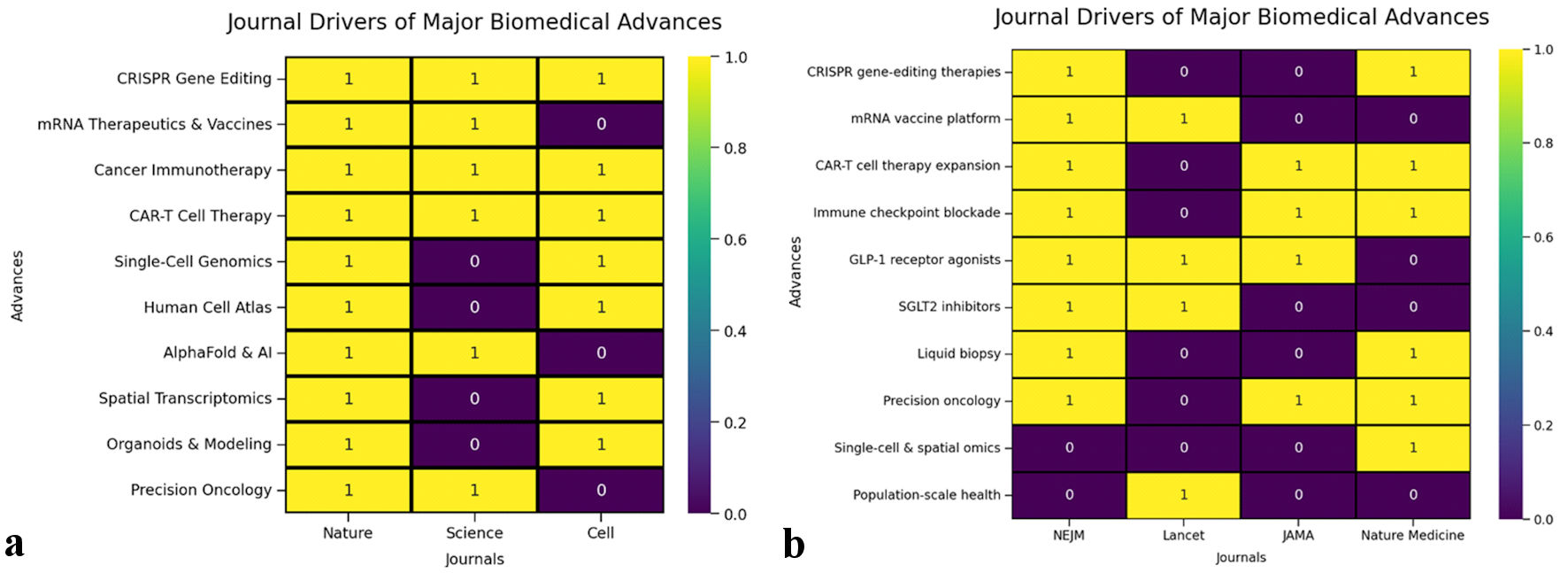 Click for large image | Figure 2. Major biomedical advances mapped across leading discovery and clinical journals. (a) Heatmap showing the contribution of leading discovery journals (Nature, Science, Cell) to key biomedical advances over the past decade. (b) Heatmap showing the evidence base from major clinical journals (New England Journal of Medicine (NEJM), The Lancet, JAMA, Nature Medicine) for the same advances. In both panels, cells are binary-coded (1, positive contribution; 0, limited contribution). Together, the heatmaps illustrate complementary roles across journals, with strong convergence for major platforms such as CRISPR, cancer immunotherapy, and cardiometabolic therapies, and domain-specific specialization spanning fundamental discovery, mechanistic insight, and clinical translation. CRISPR: clustered regularly interspaced short palindromic repeats; CAR-T: chimeric antigen receptor T-cell; GLP-1: glucagon-like peptide-1; SGLT2: sodium-glucose cotransporter 2. |
| AI-Assisted Synthesis From Clinical Flagship Journals: New England Journal of Medicine (NEJM), The Lancet, JAMA and Nature Medicine | ▴Top |
To define the most impactful advances in medical science over the past decade from a clinical perspective, we integrated outputs from multiple AI platforms—ChatGPT, DeepSeek, Gemini, Copilot, Perplexity, and Grok—focused specifically on four flagship journals: NEJM, The Lancet, JAMA, and Nature Medicine. Each system contributed distinct strengths: ChatGPT and Gemini excelled at thematic synthesis across specialties; DeepSeek emphasized mechanistic and trial-level detail; Copilot enforced structural and translational coherence; Perplexity prioritized citation-grounded evidence; and Grok highlighted rapidly emerging practice-changing trends. Triangulating these models across high-impact clinical trials and landmark studies yielded a convergent set of advances, including mRNA vaccines for coronavirus disease 2019 (COVID-19) [1], CRISPR-based gene editing for hematologic diseases [2], GLP-1–based obesity therapeutics [6], AI-enabled imaging diagnostics [7], and liquid biopsy for cancer management [8]. These breakthroughs collectively illustrate a shift toward programmable therapeutics, data-driven precision medicine, and continuous, minimally invasive disease monitoring. The agreement across independent AI systems and across journals with distinct editorial priorities underscores the robustness of these selections and demonstrates how multi-model AI synthesis can serve as a scalable, unbiased framework for mapping clinical innovation (Table 2, Figs. 2b, 3).
Click to view | Table 2. Consensus Top 10 Medical Advances (NEJM + Lancet + JAMA + Nature Medicine) |
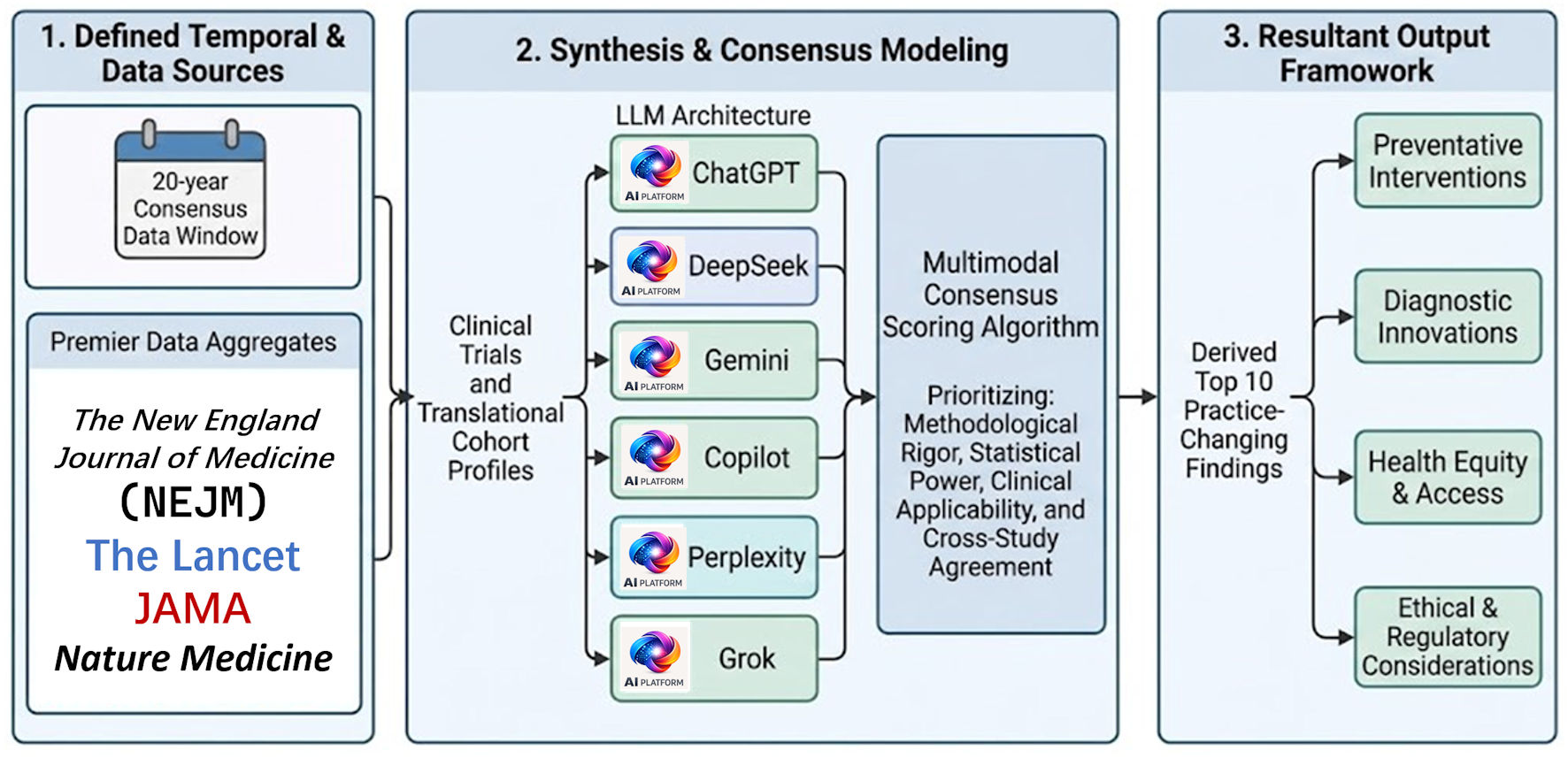 Click for large image | Figure 3. Methodological pipeline for multi-AI evaluation of clinical evidence frameworks. This schematic illustrates the three-stage algorithmic pipeline used to ingest, evaluate, and categorize high-impact clinical evidence published over the past decade. Temporal window and source journals (data ingestion): Data inputs are strictly constrained to a longitudinal 10-year publication window. Source literature is derived exclusively from the premier clinical and translational databases, including the New England Journal of Medicine (NEJM), The Lancet, JAMA, and Nature Medicine. Extracted data matrices comprise comprehensive clinical trials and translational cohort profiles. Evaluation and scoring layers (parallel large language model (LLM) processing): Ingested profiles are processed asynchronously and in parallel across six independent LLM architectures: ChatGPT, DeepSeek, Gemini, Copilot, Perplexity, and Grok. Independent AI-generated evaluation metrics are subsequently integrated via a standardized consensus scoring model. The consensus framework is mathematically weighted to prioritize three core clinical vectors: real-world clinical impact, citation kinetics (bibliometric velocity), and practice-changing potential. Output taxonomy (downstream mapping): The pipeline resolves into the top 10 consensus findings based on cumulative algorithmic ranking. These definitive insights are systematically branched and mapped onto four vital pillars of modern medicine: therapeutics, precision medicine, cellular biology, and population health. AI: artificial intelligence. |
This framework integrates leading biomedical journals (Nature, Science, Cell, NEJM, Lancet, JAMA, Nature Medicine) with multiple AI platforms (ChatGPT, DeepSeek, Gemini, Copilot, Perplexity, Grok) to generate a unified synthesis of the decade’s most influential medical breakthroughs (Fig. 4). A multi-AI integration layer performs semantic analysis, cross-validation, and clustering of high-impact findings, while a consensus engine ranks breakthroughs using citation weighting, translational impact, and clinical adoption metrics. The resulting Top 10 list spans mRNA vaccines, CRISPR editing, spatial multi-omics, AlphaFold, chimeric antigen receptor T-cell (CAR-T) therapy, GLP-1 agents, checkpoint blockade, circulating tumor DNA (ctDNA) diagnostics, microbiome therapeutics, and AI-driven clinical systems. A final validation filter ensures robustness through regulatory approvals, late-phase trials, real-world outcomes, and citation density in major clinical journals.
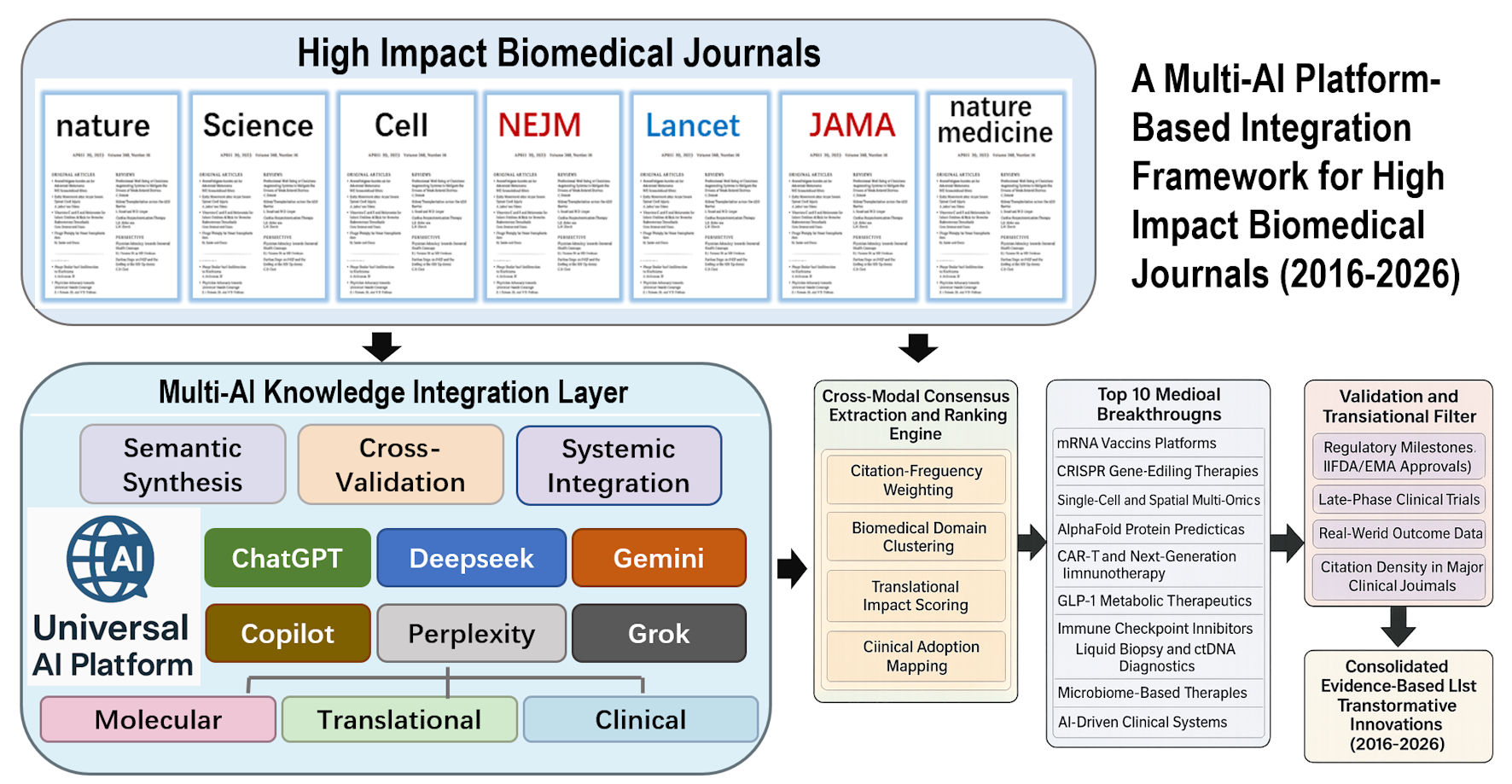 Click for large image | Figure 4. High-impact biomedical journal integration framework (2016–2026). Schematic overview of the multi-layered, AI-driven pipeline utilized to identify, aggregate, and validate the decade’s most influential medical breakthroughs. The upper tier integrates data ingestion from seven leading biomedical journals (Nature, Science, Cell, New England Journal of Medicine (NEJM), The Lancet, JAMA, and Nature Medicine) serving as the primary literature sources. The multi-AI knowledge integration layer synthesizes these data by executing semantic synthesis, cross-validation, and cross-domain clustering of high-impact findings across molecular, translational, and clinical domains using six advanced large language models (ChatGPT, DeepSeek, Gemini, Copilot, Perplexity, and Grok). Downstream processing by the Cross-Modal Consensus Extraction and Ranking Engine scores these findings based on citation-frequency weighting, domain clustering, translational impact, and clinical adoption mapping to generate a prioritized consensus list. This pipeline identifies the Top 10 Medical Breakthroughs—ranging from mRNA vaccine platforms and CRISPR therapies to AlphaFold protein prediction and AI-driven clinical systems. Finally, candidates pass through a rigorous Validation and Translational Filter evaluating regulatory milestones (FDA/EMA approvals), late-phase clinical trial data, real-world outcomes, and clinical citation density to yield a consolidated, evidence-based list of transformative innovations spanning 2016 to 2026. Arrows indicate the directional flow of data synthesis, evaluation, and empirical validation. AI: artificial intelligence; CRISPR: clustered regularly interspaced short palindromic repeats; FDA: US Food and Drug Administration; EMA: European Medicines Agency. |
mRNA vaccine revolution
The mRNA vaccine revolution represents one of the most profound turning points in modern biomedical science. What began as a niche therapeutic concept matured, almost overnight, into a globally validated platform during the COVID-19 pandemic. At its foundation, mRNA technology provides a programmable, modular system: scientists can encode virtually any antigen, synthesize the construct rapidly, and deliver it safely using lipid nanoparticles (LNPs). This flexibility enabled an unprecedented response to severe acute respiratory syndrome coronavirus 2 (SARS-CoV-2), compressing vaccine development timelines from years to months.
A key enabler of this success was the refinement of LNP delivery systems, which protect mRNA from degradation and promote efficient cellular uptake. Once inside host cells, the mRNA is translated into viral antigen, triggering a robust adaptive immune response without any risk of genomic integration. The pivotal phase III trials—Polack et al (NEJM, 2020) for BNT162b2 [1] and Baden et al (NEJM, 2021) for mRNA-1273 [9]—provided the first large-scale clinical validation of RNA-based vaccines. Complementing these findings, Pardi et al (Nat Rev Drug Discov, 2021) synthesized the mechanistic and translational foundations of the platform [10]. Even before the pandemic, Sahin et al (Nature, 2017) demonstrated the feasibility of personalized mRNA cancer vaccines targeting patient-specific neoantigens [11].
The impact extends far beyond infectious disease control. mRNA technology is now driving a shift toward individualized oncology, where tumor-specific vaccines can be rapidly designed to complement checkpoint inhibitors and other immunotherapies. Ultimately, mRNA vaccines have established RNA therapeutics as a clinically validated class, marking a transition toward agile, anticipatory, and precision-driven medicine.
CRISPR genome editing in human disease
CRISPR genome editing has rapidly evolved from a bacterial immune mechanism into one of the most powerful therapeutic tools in modern medicine. Its defining strength lies in its precision: CRISPR-Cas systems can target specific genomic loci and introduce edits with unprecedented accuracy, enabling true correction of disease-causing mutations. This shift from managing symptoms to rewriting the underlying genetic code, marks a fundamental transformation in how clinicians and scientists approach monogenic disorders.
Early breakthroughs focused on ex vivo editing, particularly for hematologic diseases. Patient-derived hematopoietic stem cells can be edited outside the body and reinfused, allowing durable correction of conditions such as β-thalassemia and sickle cell disease. The landmark trial by Frangoul et al (NEJM, 2021) demonstrated that CRISPR-edited cells could eliminate transfusion dependence and prevent vaso-occlusive crises [2]. Parallel advances in base editing, pioneered by Komor et al (Nature, 2016) [12], introduced a way to convert single nucleotides without double-strand breaks, reducing off-target risks. This was followed by prime editing, introduced by Anzalone et al (Nature, 2019) [13], which expanded the editing toolkit to include precise insertions, deletions, and all possible base substitutions.
A major milestone came with in vivo CRISPR delivery, where editing occurs directly inside the patient. Gillmore et al (NEJM, 2021) provided the first clinical evidence that systemic CRISPR infusion could safely reduce pathogenic transthyretin protein levels in amyloidosis [14].
Together, these advances signal a transition from lifelong symptomatic management to the possibility of one-time genomic cures, reshaping the therapeutic landscape for inherited diseases.
Single-cell and spatial multi-omics
Single-cell and spatial multi-omics technologies have fundamentally reshaped our understanding of tissue biology, revealing the extraordinary heterogeneity that exists within organs, tumors, and developing systems. Unlike bulk sequencing, which averages signals across thousands or millions of cells, single-cell RNA sequencing (scRNA-seq) enables high-resolution profiling of individual cellular states. This shift has allowed researchers to map developmental trajectories, identify rare cell populations, and uncover previously unrecognized immune and stromal subsets.
The vision for a comprehensive Human Cell Atlas was articulated by Regev et al (Cell, 2017) [3], establishing the conceptual and methodological foundations for global-scale single-cell mapping. Since then, scRNA-seq atlases have expanded across tissues, species, and disease contexts. In oncology, single-cell profiling has been transformative. Han et al (Nature, 2020) [15] demonstrated how tumors comprise complex ecosystems of malignant, immune, and stromal cells, each contributing to progression, immune evasion, and therapeutic resistance.
A major leap came with spatial transcriptomics, which preserves the physical architecture of tissues while capturing gene expression patterns. Marx (Nature, 2021) [16] highlighted how spatial methods, such as Slide-seq, Visium, and MERFISH, enable researchers to visualize cellular neighborhoods, lineage interactions, and microenvironmental niches with unprecedented clarity.
Together, these technologies have reframed cancer not as a uniform mass but as a dynamic ecosystem, where cellular interactions and spatial organization are as important as genetic mutations. This paradigm shift is now influencing diagnostics, biomarker discovery, and therapeutic design, pushing the field toward ecosystem-aware precision oncology.
AlphaFold and protein structure prediction
AI has transformed structural biology through breakthroughs in protein structure prediction, culminating in near-experimental accuracy for a vast portion of the proteome. For decades, predicting a protein’s three-dimensional (3D) structure from its amino acid sequence, known as the “protein folding problem”, was considered one of biology’s grand challenges. Traditional computational methods struggled with accuracy, and experimental techniques such as X-ray crystallography and cryo-electron microscopy (cryo-EM), while powerful, were time-consuming and resource-intensive.
The release of AlphaFold2 by Jumper et al (Nature, 2021) [4] marked a watershed moment. Using deep learning architectures trained on evolutionary, structural, and physicochemical constraints, AlphaFold2 achieved accuracy comparable to experimental methods in the CASP14 competition. Shortly thereafter, Tunyasuvunakool et al (Nature, 2021) [17] extended this approach to generate proteome-scale predictions across multiple species, providing structural coverage for nearly all known proteins.
In parallel, Baek et al (Science, 2021) introduced RoseTTAFold, an independent AI system capable of predicting structures using a three-track neural network that integrates sequence, distance, and coordinate information [18]. The convergence of these methods has democratized access to structural biology, enabling researchers worldwide to explore protein function, evolutionary relationships, and disease-associated variants without requiring laboratory-based structure determination.
The impact is profound: AI-driven structure prediction is accelerating drug discovery pipelines, enabling rational design of therapeutics, and providing insights into previously intractable protein families. With structural coverage now extending across entire proteomes, biology has entered an era where sequence-to-structure inference is routine rather than aspirational.
CAR-T and cellular immunotherapy
CAR-T cell therapy has reshaped the treatment landscape for hematologic malignancies, offering a fundamentally new therapeutic concept: a living drug capable of persisting, expanding, and eliminating cancer cells long after infusion. By engineering a patient’s own T cells to express chimeric antigen receptors (CARs), clinicians can redirect the immune system toward malignant targets with remarkable potency. This approach has produced some of the most dramatic clinical responses ever observed in refractory leukemia and lymphoma.
The pivotal trial by Maude et al (NEJM, 2018) demonstrated the transformative potential of tisagenlecleucel in pediatric and young adult acute lymphoblastic leukemia, achieving high rates of durable remission in patients who had exhausted all other options [19]. Similarly, Neelapu et al (NEJM, 2017) showed that axicabtagene ciloleucel could induce rapid and sustained responses in relapsed or refractory large B-cell lymphoma [20]. These successes established CAR-T therapy as a cornerstone of modern hematologic oncology.
Foundational principles of CAR-T engineering including costimulatory domains, manufacturing workflows, and strategies to mitigate toxicity were synthesized by June et al (Science, 2018) [21], guiding the next generation of cellular therapies.
The field is now expanding beyond blood cancers. Early clinical studies suggest that CAR-T cells may be effective in autoimmune diseases, such as lupus, by selectively depleting pathogenic B-cell populations. Parallel efforts aim to overcome the barriers of solid tumors, including antigen heterogeneity, immunosuppressive microenvironments, and physical stromal barriers.
Together, these advances mark the beginning of a new therapeutic era where engineered immune cells can deliver durable, potentially curative responses across a widening range of diseases.
GLP-1 receptor agonists and the metabolic revolution
GLP-1 receptor agonists have ushered in a paradigm shift in the management of obesity and cardiometabolic disease. Originally developed for type 2 diabetes, these agents harness the incretin pathway to enhance insulin secretion, reduce appetite, slow gastric emptying, and promote sustained weight loss. Their impact has extended far beyond glycemic control, positioning GLP-1–based therapies as some of the most effective pharmacologic tools for obesity ever developed.
The STEP-1 trial by Wilding et al (NEJM, 2021) demonstrated that once-weekly semaglutide produced unprecedented weight loss in individuals with obesity, with many participants achieving reductions exceeding 15% of body weight [6]. Building on this, Jastreboff et al (NEJM, 2022) showed that tirzepatide, a dual GLP-1/ gastric inhibitory polypeptide (GIP) agonist, achieved even greater weight-loss efficacy, setting a new benchmark for metabolic therapeutics [22].
The physiological foundations of GLP-1 signaling were comprehensively reviewed by Drucker (Cell Metabolism, 2018) [23], highlighting its roles in appetite regulation, cardiovascular protection, and energy balance. These mechanistic insights help explain why GLP-1–based therapies not only reduce weight but also improve blood pressure, lipid profiles, and inflammatory markers.
The broader impact is profound: GLP-1 receptor agonists represent the first highly effective, scalable pharmacologic treatments for obesity, a condition historically resistant to medication. Their cardiovascular benefits, demonstrated across multiple outcome trials, suggest the potential for population-level reductions in heart disease, stroke, and metabolic complications.
As next-generation incretin therapies emerge, the field is moving toward a future where obesity and cardiometabolic disease can be treated with the same precision and efficacy as other chronic conditions.
Immune checkpoint blockade
Immune checkpoint blockade has transformed oncology by revealing that even advanced cancers can be controlled, sometimes for years, when inhibitory pathways on T cells are released. Tumors exploit immune checkpoints such as programmed cell death protein 1 (PD-1) and cytotoxic T-lymphocyte–associated protein 4 (CTLA-4) to suppress antitumor immunity. Blocking these pathways reactivates exhausted T cells, enabling durable tumor regression across multiple cancer types.
The foundational clinical evidence emerged from early PD-1 inhibitor trials. Topalian et al (NEJM, 2012) demonstrated that PD-1 blockade produced meaningful and often long-lasting responses in melanoma, renal cell carcinoma, and non-small cell lung cancer [5]. These findings were expanded in subsequent reports through 2015, establishing PD-1 inhibition as a broadly effective therapeutic strategy. Robert et al (NEJM, 2015) showed that pembrolizumab significantly improved survival in advanced melanoma compared with ipilimumab, marking a pivotal shift in frontline therapy [24].
Mechanistic insights were synthesized by Sharma et al (Science, 2015) [25], who described how CTLA-4 and PD-1 regulate distinct phases of T-cell activation and exhaustion. Their work provided the conceptual framework for combination checkpoint blockade, now a standard approach in several malignancies.
The impact of checkpoint inhibitors is profound: long-term survival, once rare in metastatic cancer, is now achievable for a subset of patients. These therapies have become the foundation of modern immune-oncology, inspiring new generations of immune-modulating agents and reshaping treatment paradigms across solid tumors.
Liquid biopsy and ctDNA diagnostics
Liquid biopsy has emerged as one of the most transformative innovations in cancer diagnostics, offering a noninvasive window into tumor biology through ctDNA. Unlike tissue biopsies, which capture only a single spatial and temporal snapshot, ctDNA reflects the dynamic, systemic nature of cancer, enabling earlier detection, real-time monitoring, and rapid identification of resistance mutations.
Wan et al (Nat Med, 2017) provided a foundational demonstration that ctDNA profiling can sensitively track tumor burden and detect clinically relevant mutations across multiple cancer types [8]. Siravegna et al (Nat Rev Clin Oncol, 2017) expanded this framework, outlining how ctDNA can guide targeted therapy selection, monitor clonal evolution, and identify mechanisms of acquired resistance [26].
A major milestone in early detection came from Lennon et al (Science, 2020), who reported results from the DETECT-A study, the first prospective, interventional trial using multi-cancer blood testing in an average-risk population [27]. The study demonstrated that blood-based screening could identify cancers before radiologic detection, with acceptable false-positive rates and actionable clinical pathways.
The impact of ctDNA diagnostics is far-reaching. Liquid biopsy enables early cancer detection, often before symptoms or imaging abnormalities appear, and provides a powerful tool for real-time tracking of tumor evolution, allowing clinicians to adjust therapy as resistance emerges. As sequencing technologies advance, ctDNA is poised to become a central pillar of precision oncology, complementing tissue genomics and reshaping cancer care across the continuum.
Microbiome therapeutics
The gut microbiome has moved from an observational curiosity to a bona fide therapeutic frontier. Early studies revealed striking associations between microbial composition and metabolic, immune, and neurologic diseases, but the field has since progressed toward establishing causal mechanisms and developing targeted interventions. Modern microbiome science now integrates metagenomics, metabolomics, gnotobiotic models, and clinical trials to understand how microbial communities shape human physiology.
Thaiss et al (Cell, 2016) provided one of the foundational mechanistic studies, demonstrating how microbial signals influence host circadian rhythms, metabolism, and inflammatory responses [28]. This work helped shift the field from correlation to causality by showing that specific microbial perturbations could directly alter host phenotypes. Smillie et al (Nature, 2018) expanded this framework by mapping microbial ecosystem dynamics during fecal microbiota transplantation (FMT), identifying donor-derived strains that successfully engraft and drive clinical benefit [29]. These insights laid the groundwork for rational microbiome therapeutics.
A major clinical milestone came with Feuerstadt et al (NEJM, 2022), who demonstrated that standardized, donor-derived microbiota therapy could prevent recurrent Clostridioides difficile infection with high efficacy and safety [30]. This represented one of the first US Food and Drug Administration (FDA)-authorized microbiome-based therapeutics, validating the concept of manipulating microbial ecosystems to treat disease.
The field is transitioning from correlation to causality to therapy, expanding across oncology, immunology, metabolic disease, and neuropsychiatry, with engineered probiotics, defined microbial consortia, and metabolite-based interventions emerging as next-generation therapeutics, positioning microbiome-based approaches as a core pillar of precision medicine alongside genomics and immunotherapy.
AI-driven clinical medicine
AI is rapidly becoming embedded in the fabric of clinical medicine, reshaping how diseases are diagnosed, monitored, and managed. Advances in deep learning have enabled algorithms to interpret images, analyze electronic health records (EHRs), and integrate multimodal data with accuracy approaching or, in some cases, surpassing human experts. Rather than replacing clinicians, AI is giving rise to the concept of the augmented clinician, where human judgment is enhanced by computational precision.
One of the earliest demonstrations of AI’s clinical potential came from Esteva et al (Nature, 2017), who showed that a convolutional neural network could classify skin lesions at dermatologist-level performance [31]. Shortly thereafter, Rajpurkar et al (Nat Med, 2018) developed CheXNet, a deep learning model capable of detecting pneumonia on chest X-rays with high accuracy [7], highlighting AI’s ability to support radiologic interpretation.
Topol (Nat Med, 2019) synthesized these developments into the “deep medicine” framework, arguing that AI can restore the human connection in healthcare by reducing administrative burden and enabling more personalized care [32]. Meanwhile, Jumper et al. (Nature, 2021) demonstrated how AlphaFold’s protein structure predictions could accelerate clinical research, from variant interpretation to drug discovery [4].
The impact is transformative. AI systems are evolving into multimodal diagnostic engines that integrate imaging, genomics, pathology, and EHR data to support real-time clinical decision-making. As regulatory frameworks mature and datasets expand, AI-driven medicine is poised to become a foundational layer of modern healthcare.
| Discussion | ▴Top |
Across these 10 breakthrough domains, three convergent themes emerge, revealing a deeper transformation in how medicine is conceptualized and practiced. First, medicine is becoming programmable. Technologies such as mRNA vaccines [1, 9–11], CRISPR genome editing [2, 12–14], and CAR-T cell therapy [19–21] share a unifying logic: biological function can now be written, edited, or re-engineered with increasing precision. These platforms operate more like software than traditional drugs: modular, updatable, and customizable to individual patients. This shift marks a profound departure from conventional pharmacology toward interventions that directly manipulate genetic, transcriptional, or cellular programs.
Second, biology is becoming computational. Advances such as AlphaFold’s protein structure prediction [4, 17, 18], single-cell and spatial multi-omics [3, 15, 16], and AI-driven diagnostics [7, 31, 32] demonstrate that biological complexity can now be measured, modeled, and predicted at unprecedented scale. Machine learning systems are decoding protein structures, mapping cellular ecosystems, and interpreting clinical images with expert-level accuracy. As multimodal datasets expand, computational biology is evolving from an analytical tool into a generative engine for discovery, accelerating everything from drug design to clinical decision-making.
Finally, disease itself is being redefined as systems-level dysregulation. Single-cell atlases reveal cancer as an evolving ecosystem of interacting malignant, immune, and stromal states [5, 24, 25]. Metabolic disorders are increasingly understood as network-level failures, illuminated by incretin-based therapies such as GLP-1 agonists [6, 22, 23]. Immune-mediated diseases are now viewed as circuit-level dysfunctions, informed by checkpoint blockade [5, 24, 25] and engineered cellular therapies [19–21].
Taken together, these themes signal a new biomedical era, one in which programmable interventions, computational insight, and systems-level understanding converge to create more predictive, personalized, and transformative healthcare.
| Concluding Remarks | ▴Top |
The past decade has transformed biomedicine through programmable therapeutics, computational biology, and systems-level reconceptualization of disease. mRNA vaccines, CRISPR editing, and CAR-T therapies demonstrate that biological function can now be engineered with unprecedented precision. Advances in single-cell atlases, spatial omics, AlphaFold, and clinical AI reveal a future where biology is increasingly computable and predictable. Meanwhile, liquid biopsy, microbiome therapeutics, metabolic agents, and immune checkpoint blockade redefine disease as dynamic network dysfunction rather than isolated pathology. Together, these breakthroughs signal a new era of predictive, personalized, and integrative medicine poised to reshape prevention, diagnosis, and therapy.
Acknowledgments
The author has no acknowledgments to declare.
Financial Disclosure
The author received no financial support for the research, authorship, or publication of this manuscript.
Conflict of Interest
The author declares no competing interests.
Author Contributions
LW conceived and designed the study, developed the analytical framework, performed all computational and bioinformatics analyses, conducted data interpretation, generated all figures and visualizations, drafted the manuscript, critically reviewed and revised the manuscript, and approved the final version for publication. LW is solely responsible for the organization, execution, interpretation, writing, revision, and overall content of the study.
Data Availability
Any inquiries regarding supporting data availability of this study should be directed to the corresponding author.
| References | ▴Top |
- Polack FP, Thomas SJ, Kitchin N, Absalon J, Gurtman A, Lockhart S, Perez JL, et al. Safety and efficacy of the BNT162b2 mRNA COVID-19 vaccine. N Engl J Med. 2020;383(27):2603-2615.
doi pubmed - Frangoul H, Altshuler D, Cappellini MD, Chen YS, Domm J, Eustace BK, Foell J, et al. CRISPR-Cas9 gene editing for sickle cell disease and beta-thalassemia. N Engl J Med. 2021;384(3):252-260.
doi pubmed - Regev A, Teichmann SA, Lander ES, Amit I, Benoist C, Birney E, Bodenmiller B, et al. The human cell atlas. Elife. 2017;6:e27041.
doi pubmed - Jumper J, Evans R, Pritzel A, Green T, Figurnov M, Ronneberger O, Tunyasuvunakool K, et al. Highly accurate protein structure prediction with AlphaFold. Nature. 2021;596(7873):583-589.
doi pubmed - Topalian SL, Hodi FS, Brahmer JR, Gettinger SN, Smith DC, McDermott DF, Powderly JD, et al. Safety, activity, and immune correlates of anti-PD-1 antibody in cancer. N Engl J Med. 2012;366(26):2443-2454.
doi pubmed - Wilding JPH, Batterham RL, Calanna S, Davies M, Van Gaal LF, Lingvay I, McGowan BM, et al. Once-weekly semaglutide in adults with overweight or obesity. N Engl J Med. 2021;384(11):989-1002.
doi pubmed - Rajpurkar P, Irvin J, Ball RL, Zhu K, Yang B, Mehta H, Duan T, et al. Deep learning for chest radiograph diagnosis: A retrospective comparison of the CheXNeXt algorithm to practicing radiologists. PLoS Med. 2018;15(11):e1002686.
doi pubmed - Wan JCM, Massie C, Garcia Corbacho J. et al. Liquid biopsies for cancer: ctDNA analysis. Nat Med. 2017;23:1436-1446.
- Baden LR, El Sahly HM, Essink B, Kotloff K, Frey S, Novak R, Diemert D, et al. Efficacy and safety of the mRNA-1273 SARS-CoV-2 vaccine. N Engl J Med. 2021;384(5):403-416.
doi pubmed - Pardi N, Hogan MJ, Porter FW, Weissman D. mRNA vaccines - a new era in vaccinology. Nat Rev Drug Discov. 2018;17(4):261-279.
doi pubmed - Sahin U, Derhovanessian E, Miller M, Kloke BP, Simon P, Lower M, Bukur V, et al. Personalized RNA mutanome vaccines mobilize poly-specific therapeutic immunity against cancer. Nature. 2017;547(7662):222-226.
doi pubmed - Komor AC, Kim YB, Packer MS, Zuris JA, Liu DR. Programmable editing of a target base in genomic DNA without double-stranded DNA cleavage. Nature. 2016;533(7603):420-424.
doi pubmed - Anzalone AV, Randolph PB, Davis JR, Sousa AA, Koblan LW, Levy JM, Chen PJ, et al. Search-and-replace genome editing without double-strand breaks or donor DNA. Nature. 2019;576(7785):149-157.
doi pubmed - Gillmore JD, Gane E, Taubel J, Kao J, Fontana M, Maitland ML, Seitzer J, et al. CRISPR-Cas9 In vivo gene editing for transthyretin amyloidosis. N Engl J Med. 2021;385(6):493-502.
doi pubmed - Han X, Zhou Z, Fei L, Sun H, Wang R, Chen Y, Chen H, et al. Construction of a human cell landscape at single-cell level. Nature. 2020;581(7808):303-309.
doi pubmed - Marx V. Method of the Year: spatially resolved transcriptomics. Nat Methods. 2021;18(1):9-14.
doi pubmed - Tunyasuvunakool K, Adler J, Wu Z, Green T, Zielinski M, Zidek A, Bridgland A, et al. Highly accurate protein structure prediction for the human proteome. Nature. 2021;596(7873):590-596.
doi pubmed - Baek M, DiMaio F, Anishchenko I, Dauparas J, Ovchinnikov S, Lee GR, Wang J, et al. Accurate prediction of protein structures and interactions using a three-track neural network. Science. 2021;373(6557):871-876.
doi pubmed - Maude SL, Laetsch TW, Buechner J, Rives S, Boyer M, Bittencourt H, Bader P, et al. Tisagenlecleucel in children and young adults with B-cell lymphoblastic leukemia. N Engl J Med. 2018;378(5):439-448.
doi pubmed - Neelapu SS, Locke FL, Bartlett NL, Lekakis LJ, Miklos DB, Jacobson CA, Braunschweig I, et al. Axicabtagene Ciloleucel CAR T-cell therapy in refractory large B-cell lymphoma. N Engl J Med. 2017;377(26):2531-2544.
doi pubmed - June CH, O'Connor RS, Kawalekar OU, Ghassemi S, Milone MC. CAR T cell immunotherapy for human cancer. Science. 2018;359(6382):1361-1365.
doi pubmed - Jastreboff AM, Aronne LJ, Ahmad NN, Wharton S, Connery L, Alves B, Kiyosue A, et al. Tirzepatide once weekly for the treatment of obesity. N Engl J Med. 2022;387(3):205-216.
doi pubmed - Drucker DJ. Mechanisms of action and therapeutic application of glucagon-like peptide-1. Cell Metab. 2018;27(4):740-756.
doi pubmed - Robert C, Schachter J, Long GV, Arance A, Grob JJ, Mortier L, Daud A, et al. Pembrolizumab versus ipilimumab in advanced melanoma. N Engl J Med. 2015;372(26):2521-2532.
doi pubmed - Sharma P, Allison JP. The future of immune checkpoint therapy. Science. 2015;348(6230):56-61.
doi pubmed - Siravegna G, Marsoni S, Siena S, Bardelli A. Integrating liquid biopsies into the management of cancer. Nat Rev Clin Oncol. 2017;14(9):531-548.
doi pubmed - Lennon AM, Buchanan AH, Kinde I, Warren A, Honushefsky A, Cohain AT, Ledbetter DH, et al. Feasibility of blood testing combined with PET-CT to screen for cancer and guide intervention. Science. 2020;369(6499):eabb9601.
doi pubmed - Thaiss CA, Levy M, Korem T, Dohnalova L, Shapiro H, Jaitin DA, David E, et al. Microbiota diurnal rhythmicity programs host transcriptome oscillations. Cell. 2016;167(6):1495-1510.e1412.
doi pubmed - Smillie CS, Sauk J, Gevers D, Friedman J, Sung J, Youngster I, Hohmann EL, et al. Strain tracking reveals the determinants of bacterial engraftment in the human gut following fecal microbiota transplantation. Cell Host Microbe. 2018;23(2):229-240.e225.
doi pubmed - Feuerstadt P, Louie TJ, Lashner B, Wang EEL, Diao L, Bryant JA, Sims M, et al. SER-109, an oral microbiome therapy for recurrent Clostridioides difficile infection. N Engl J Med. 2022;386(3):220-229.
doi pubmed - Esteva A, Kuprel B, Novoa RA, Ko J, Swetter SM, Blau HM, Thrun S. Dermatologist-level classification of skin cancer with deep neural networks. Nature. 2017;542(7639):115-118.
doi pubmed - Topol EJ. High-performance medicine: the convergence of human and artificial intelligence. Nat Med. 2019;25(1):44-56.
doi pubmed
This article is distributed under the terms of the Creative Commons Attribution 4.0 International License (CC BY 4.0), which permits unrestricted use, distribution, and reproduction in any medium, including commercial use, provided the original work is properly cited.
AI in Clinical Medicine is published by Elmer Press Inc.