

A Machine Learning Model to Guide Computed Tomography Angiography Use in Acute Gastrointestinal Bleeding: A Decision-Support Tool for Gray-Zone Cases
DOI:
https://doi.org/10.14740/aicm15Keywords:
Gastrointestinal bleeding, CT angiography, Machine learning, Decision support, Predictive modelingAbstract
Background: Computed tomography (CT) angiography (CTA) is an essential imaging tool in gastrointestinal (GI) bleeding but lacks clear guidance for use among hospitalized patients who develop new or worsening bleeding after admission, where hemodynamic findings and endoscopic visualization are often equivocal. These “gray-zone” cases create uncertainty about whether CTA will yield actionable results. We aimed to develop and evaluate an interpretable machine learning (ML) model to estimate the probability of a positive CTA in this inpatient context and support selective, evidence-based imaging decisions.
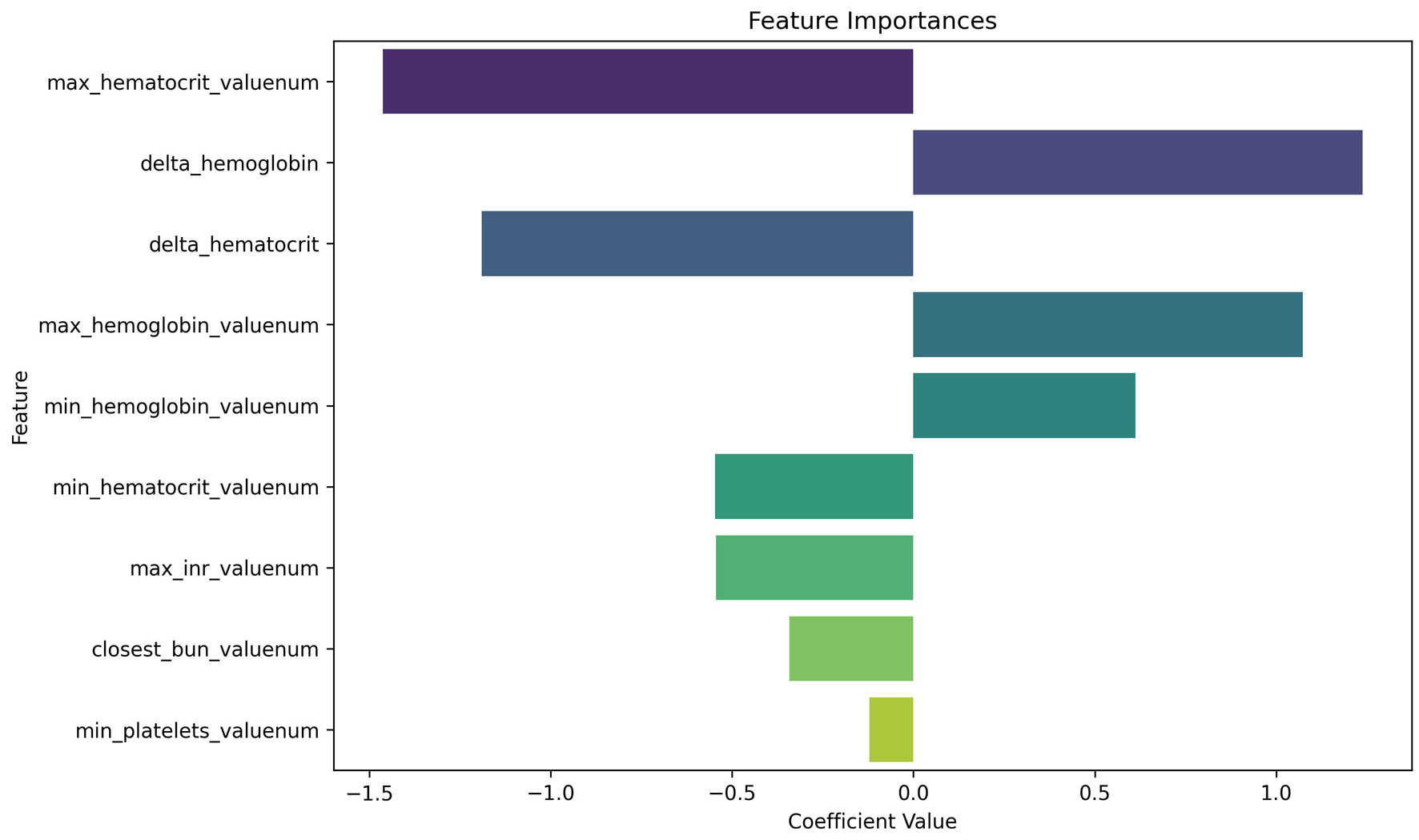
Methods: We retrospectively analyzed 11,938 patients with GI bleeding from the MIMIC-IV database, a publicly available inpatient database from Beth Israel Deaconess Medical Center. Among 890 CTA studies, 140 met inclusion criteria after excluding non-bleeding indications and incomplete laboratory data, including 32 CTA-positive and 108 CTA-negative examinations. A logistic-regression model with Synthetic Minority Oversampling Technique (SMOTE) upsampling was trained using seven routine laboratory features—hemoglobin, hematocrit, international normalized ratio (INR), blood urea nitrogen, and platelets—measured within the 24 h preceding the CTA order. Model performance was assessed using F1 score, recall, and area under the receiver operating characteristic curve (ROC-AUC).
Results: The model achieved an F1 score of 0.71, recall of 0.68, and ROC-AUC of 0.71, outperforming random forest and XGBoost classifiers. Key predictors included Δ-hemoglobin, Δ-hematocrit, and maximum INR, which captured physiologic patterns associated with active bleeding.
Conclusions: This proof-of-concept model demonstrates that routine inpatient laboratory data can predict the likelihood of a positive CTA among patients with suspected GI bleeding during hospitalization. By quantifying imaging yield using data already available in the electronic health record, the model offers a practical, interpretable framework to guide selective CTA utilization, reduce unnecessary scans, and improve multidisciplinary decision-making.
Published
Issue
Section
License
Copyright (c) 2026 The authors

This work is licensed under a Creative Commons Attribution 4.0 International License.