

Artificial Intelligence Applications in Pediatric Obesity Medicine: Bridging Predictive Analytics, Clinical Decision Support, and Family-Centered Care
DOI:
https://doi.org/10.14740/aicm18Keywords:
Artificial intelligence, Machine learning, Pediatric obesity, Childhood obesity, Predictive analytics, Clinical decision support, Telemedicine, Precision medicineAbstract
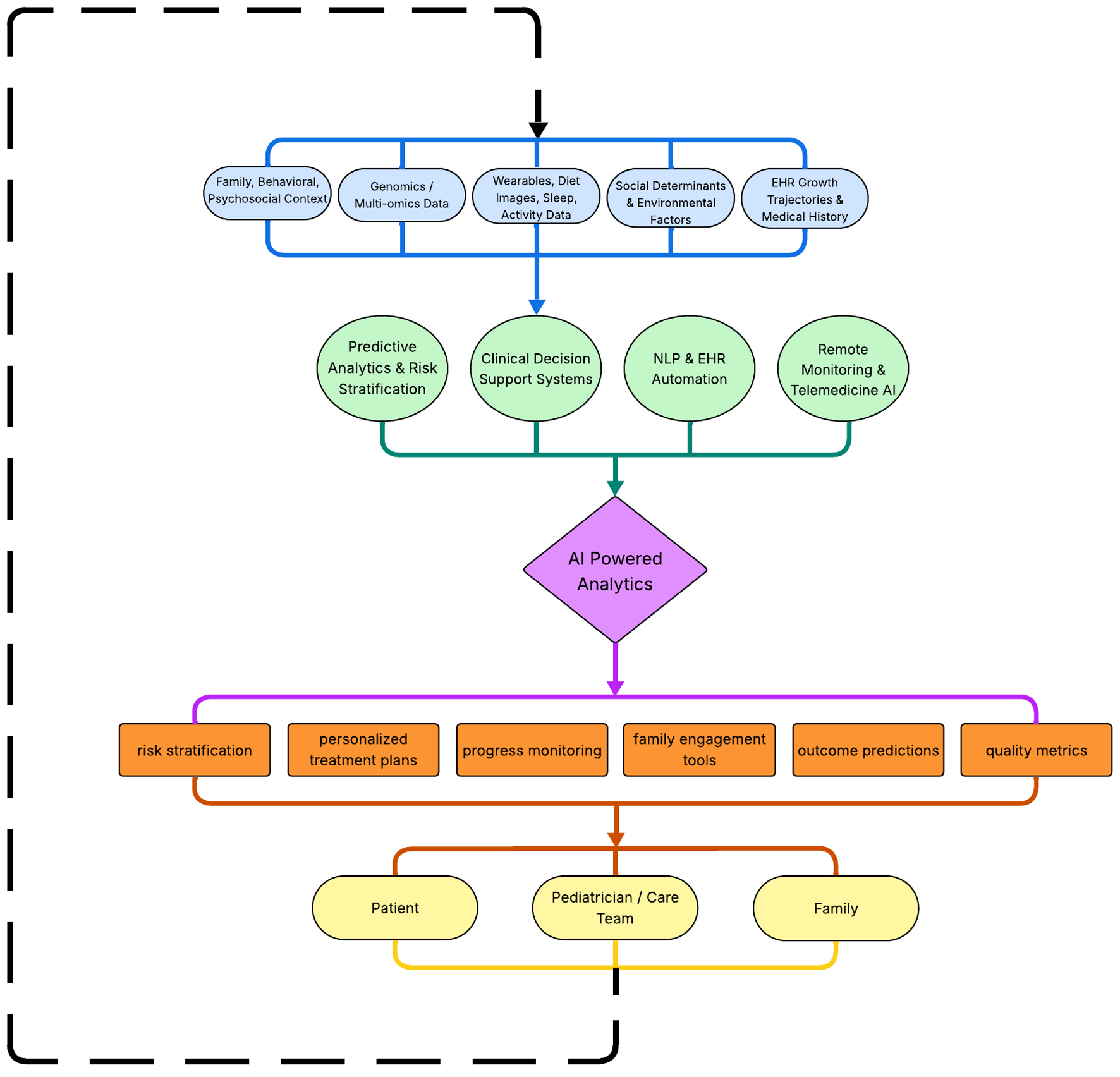
Childhood obesity represents a significant public health challenge, affecting over 340 million children and adolescents worldwide. Despite the implementation of various intervention strategies, prevalence rates continue to rise. Artificial intelligence (AI) technologies offer considerable potential to address this crisis by enhancing risk prediction and individualizing treatment plans through scalable, family-oriented interventions. This review examines current evidence regarding AI applications in pediatric obesity medicine, with a focus on clinical utility, evaluation, and recommendations for future implementation. A comprehensive narrative review of the peer-reviewed literature was conducted to evaluate the applications of AI in pediatric obesity care. The review encompassed predictive analytics, clinical decision support systems (CDSS), remote monitoring technologies, and natural language processing (NLP) tools. PubMed, Scopus, and IEEE databases were systematically searched for studies published between 2015 and 2024 with a focus on validated AI systems with demonstrated clinical applications in pediatric populations. Studies were identified using combinations of keywords including “artificial intelligence,” “machine learning,” “deep learning,” “pediatric obesity,” “clinical decision support,” “predictive analysis,” “telemedicine,” “remote monitoring,” and “natural language processing.” Inclusion criteria included peer-reviewed English-language publications that described AI applications with relevance to pediatric obesity screening, prevention, or management. Studies were excluded if they addressed adult populations exclusively or focused on AI methodology without clinical application. Reference lists of relevant articles were also reviewed to identify additional eligible studies. Two authors (JRP and VSC) independently screened titles and abstracts, with discrepancies resolved through discussion. It is important to note that no AI system is currently approved or used in routine pediatric obesity clinical care; most applications described in this review remain in research or early pilot phases. AI applications demonstrate significant potential in managing various aspects of pediatric obesity. Machine learning algorithms facilitate earlier identification of high-risk children, achieving 75–90% accuracy in predicting obesity risk, as reported in studies employing logistic regression, random forest, and gradient boosting models on longitudinal electronic health record datasets. CDSS can generate effective treatment recommendations tailored to individual metabolic profiles, behavioral patterns, and family circumstances. Remote monitoring platforms that incorporate wearable devices and mobile health applications enable patient engagement and real-time adjustments to interventions. Automated screening and documentation through NLP tools may reduce clinician workload and enhance care quality. However, major implementation challenges include algorithmic bias, data breach risks, limited interoperability, and disparities in patient access to technology. AI applications enhance prediction accuracy, enable personalized interventions, and increase scalability, thereby offering substantial opportunities to advance pediatric obesity care. Key steps for effective integration involve addressing technical challenges, enhancing equity and access, ensuring clinical oversight, and adhering to family-centered care principles. Future research should prioritize improving validation across diverse populations by assessing long-term outcomes and developing implementation frameworks that support, rather than replace, the therapeutic relationship between communities and healthcare providers.
Published
Issue
Section
License
Copyright (c) 2026 The authors

This work is licensed under a Creative Commons Attribution 4.0 International License.