

Optimizing the Use of AI Agents in Electronic Health Record Workflows in Healthcare: Clinical Integration and Human Factors Review
DOI:
https://doi.org/10.14740/aicm35Keywords:
Artificial intelligence, Electronic Health Records, Ambient AI scribes, Microsoft Copilot, Human factors engineering, Cognitive loadAbstract
Background: Electronic Health Record (EHR) systems impose substantial administrative burden on clinicians and are strongly associated with cognitive overload and professional burnout. In parallel, autonomous and semi-autonomous artificial intelligence (AI) agents—such as ambient documentation scribes, Microsoft Copilot, ChatGPT-based tools, and clinical chatbots—provide transformative potential to re-engineer EHR-mediated workflows in healthcare. If poorly integrated, however, these agents can introduce verification bottlenecks, hallucination risks, and new sources of cognitive load. The study aimed to evaluate clinical operational transformations driven by EHR-integrated AI agents, synthesize human factors engineering (HFE) design frameworks, and establish practical guidelines for integrating conversational AI into hospital IT infrastructure.
Methods: A PRISMA 2020–guided systematic review was conducted across PubMed/MEDLINE, Embase, IEEE Xplore, and Scopus to identify empirical studies evaluating cognitive load, AI agent usability, workflow throughput, and error profiles in AI agent–assisted health IT environments. Eligible studies enrolled clinicians using EHRs in inpatient or outpatient care, deployed autonomous or semi-autonomous AI agents integrated with EHR workflows, and reported human-centered outcomes such as documentation time, administrative time, NASA-TLX cognitive load, System Usability Scale (SUS) scores, and hallucination or omission rates.
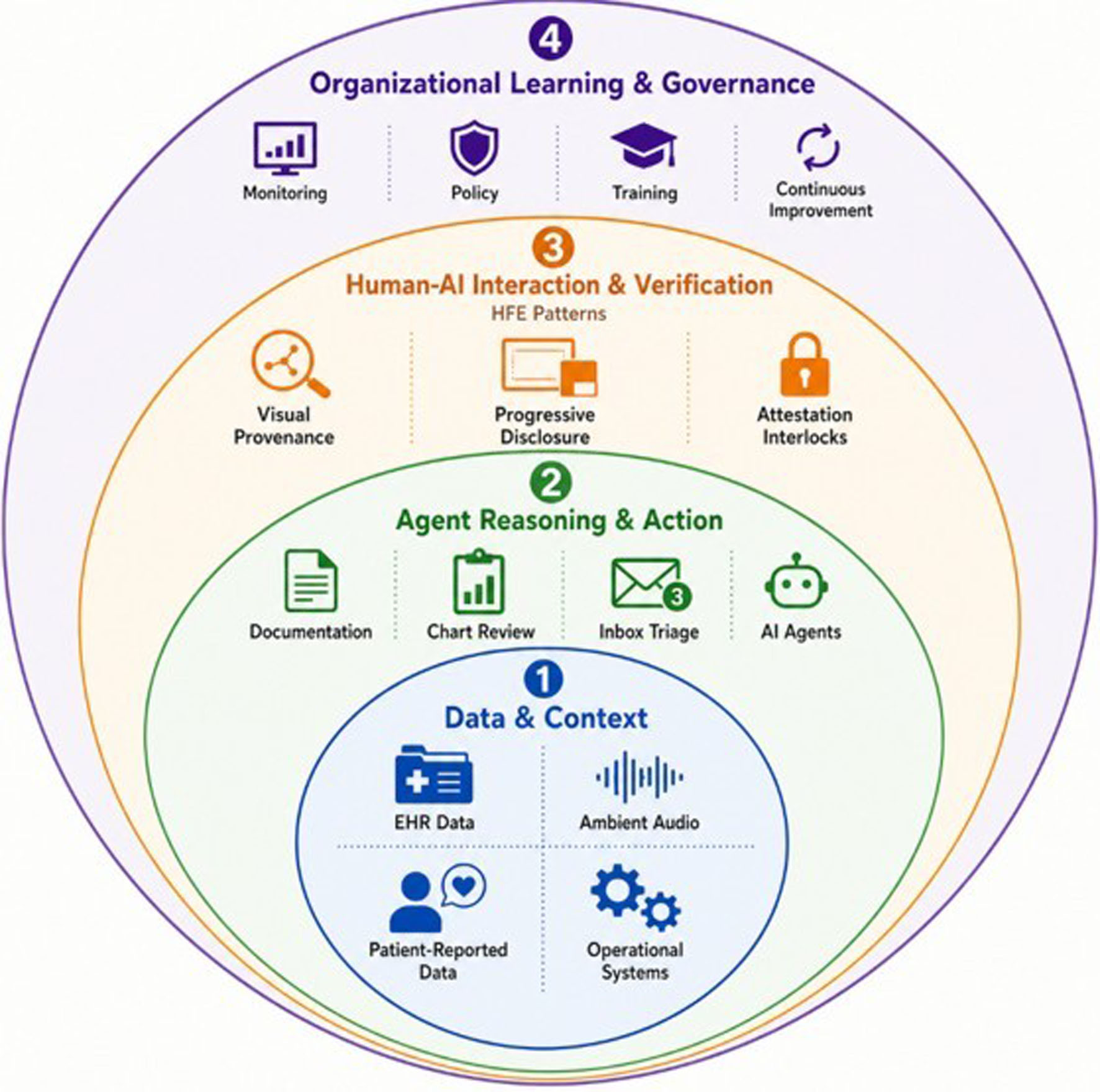
Results: Across ambient AI scribe implementations and AI-assisted documentation workflows, AI agent deployment reduced per-patient documentation time by approximately 75%, daily administrative overhead by about 60%, and after-hours “pajama time” by up to 70%. Quantitative measures of cognitive workload and usability generally improved, but new burdens emerged around verification, auditing, and management of AI-generated content. Three core HFE integration patterns—visual provenance, progressive disclosure, and attestation interlocks—were identified as effective strategies to mitigate verification fatigue and reduce hallucination risk when embedded into EHR-native interfaces.
Conclusions: Clinical engineers and healthcare IT leaders need to prioritize HFE-driven integration architectures when deploying AI agents into EHR workflows. Without robust visual grounding and verification workflows, gains in generative efficiency are offset by downstream cognitive overload. Embedding AI agents via SMART on FHIR within native EHR environments, coupled with human-in-the-loop safety interlocks, can safely translate generative AI gains into improved clinical decision-making, operational throughput, and provider well-being.
Published
Issue
Section
License
Copyright (c) 2026 The authors

This work is licensed under a Creative Commons Attribution 4.0 International License.